Skip to main content
Introduction to Chemistry
Il mio corso
Impara
Preparazione agli esami
AI Tutor
Guide di studio
Flashcard
Esplora
Prova l'app
Il mio corso
Impara
Preparazione agli esami
AI Tutor
Guide di studio
Flashcard
Esplora
Prova l'app
Indietro
Gas Evolution Equations (Simplified) quiz
Puoi toccare per girare la carta.
What is a gas evolution equation?
Puoi toccare per girare la carta.
👆
What is a gas evolution equation?
A gas evolution equation is a molecular equation that involves the creation of a gas, such as carbon dioxide, during a chemical reaction.
Avanzamenti del tracciato
I pulsanti di controllo sono stati cambiati in modalità "navigazione".
1/15
Flashcard correlate
Pratica correlata
Video consigliati
Gas Evolution Equations (Simplified) definitions
Gas Evolution Equations (Simplified)
12 Termini
Gas Evolution Equations (Simplified)
7. Chemical Reactions
5 Problemi
Argomento
Complete Ionic Equations
7. Chemical Reactions
5 Problemi
Argomento
7. Chemical Reactions
8 Argomenti
24 Problemi
Capitolo
VideoThumbView.guidedCourse
01:33
Gas Evolution Equations (Simplified) Concept 1
3058
views
10
rank
VideoThumbView.guidedCourse
03:17
Gas Evolution Equations (Simplified) Example 1
6744
views
28
rank
Termini in questo insieme (15)
Nascondere definizioni
What is a gas evolution equation?
A gas evolution equation is a molecular equation that involves the creation of a gas, such as carbon dioxide, during a chemical reaction.
Which gas is commonly formed in gas evolution equations discussed in this lesson?
Carbon dioxide (CO2) is commonly formed in the gas evolution equations discussed.
What is meant by a 'median product' in a gas evolution equation?
A median product is an intermediate form of the product that exists before it fully converts into the final product.
What happens to the median product in a gas evolution equation?
The median product loses a water molecule to become the final product, which is often a gas.
Which ions typically react to form carbonic acid as a median product?
The H+ ion reacts with the bicarbonate ion to form carbonic acid as a median product.
Why can't carbonic acid remain as a product in these reactions?
Carbonic acid is unstable and automatically decomposes, losing water to form carbon dioxide gas.
What are the final products when carbonic acid decomposes?
The final products are carbon dioxide gas (CO2) and water (H2O).
What is the general process illustrated by a gas evolution equation?
The process involves the formation of a median product that loses water to produce a gas and water.
What happens to the water molecule that is 'subtracted' from the median product?
The water molecule remains in the reaction mixture as a liquid.
What is the chemical formula for carbonic acid?
The chemical formula for carbonic acid is H2CO3.
What is the result of H+ reacting with the carbonate ion?
H+ reacting with the carbonate ion also forms carbonic acid, which then decomposes to CO2 and water.
How does the gas evolution equation explain the formation of CO2 gas?
It explains that CO2 gas is formed when carbonic acid decomposes by losing water.
What physical states are assigned to the products in a gas evolution equation involving carbonic acid?
CO2 is a gas and water (H2O) is a liquid.
Why is it important to recognize the formation of a median product in these reactions?
Recognizing the median product helps understand the stepwise process leading to gas formation.
What is the overall summary of a gas evolution equation involving H+ and bicarbonate?
H+ reacts with bicarbonate to form carbonic acid, which then decomposes into CO2 gas and water.
 IndietroIndietro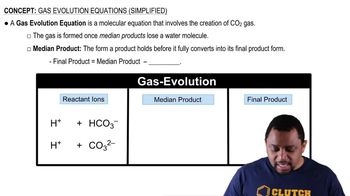
 01:33
01:33