Skip to main content
Introduction to Chemistry
Il mio corso
Impara
Preparazione agli esami
AI Tutor
Guide di studio
Flashcard
Esplora
Prova l'app
Il mio corso
Impara
Preparazione agli esami
AI Tutor
Guide di studio
Flashcard
Esplora
Prova l'app
Indietro
Heat Capacity quiz
Puoi toccare per girare la carta.
What is the relationship between heat (q) and temperature change (Δt) in a substance?
Puoi toccare per girare la carta.
👆
What is the relationship between heat (q) and temperature change (Δt) in a substance?
Heat is directly proportional to the temperature change; more heat applied results in a greater temperature change.
Avanzamenti del tracciato
I pulsanti di controllo sono stati cambiati in modalità "navigazione".
1/15
Flashcard correlate
Pratica correlata
Video consigliati
Heat Capacity definitions
Heat Capacity
11 Termini
Heat Capacity
3. Matter and Energy
5 Problemi
Argomento
Thermal Equilibrium (Simplified)
3. Matter and Energy
5 Problemi
Argomento
3. Matter and Energy - Part 1 of 2
12 Argomenti
34 Problemi
Capitolo
3. Matter and Energy - Part 2 of 2
1 Argomento
3 Problemi
Capitolo
VideoThumbView.guidedCourse
00:44
Heat Capacity
10244
views
63
rank
VideoThumbView.guidedCourse
02:08
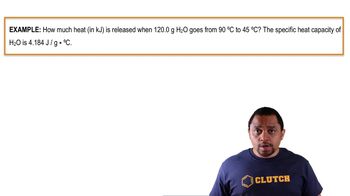
Heat Capacity Example 3
9592
views
72
rank
VideoThumbView.guidedCourse
01:47
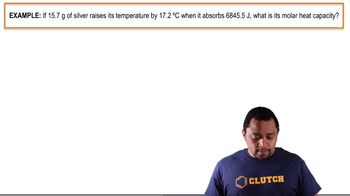
Heat Capacity Example 2
10027
views
81
rank
3
comments
Termini in questo insieme (15)
Nascondere definizioni
What is the relationship between heat (q) and temperature change (Δt) in a substance?
Heat is directly proportional to the temperature change; more heat applied results in a greater temperature change.
What does heat capacity (C) represent?
Heat capacity is the amount of heat required to change the temperature of a weighted substance.
How is specific heat capacity (c) defined?
Specific heat capacity is the amount of heat required to change the temperature of 1 gram of a substance by 1 degree (Celsius or Kelvin).
What is molar heat capacity (C)?
Molar heat capacity is the amount of heat required to change the temperature of 1 mole of a substance by 1 degree (Celsius or Kelvin).
What formula is used to calculate molar heat capacity?
Molar heat capacity (C) is calculated as C = q / (n × Δt), where n is the number of moles.
What formula is used to calculate specific heat capacity?
Specific heat capacity (c) is calculated as c = q / (m × Δt), where m is the mass in grams.
What units are used for specific heat capacity?
Specific heat capacity is measured in joules per gram per degree Celsius or Kelvin (J/g·°C or J/g·K).
What units are used for molar heat capacity?
Molar heat capacity is measured in joules per mole per degree Celsius or Kelvin (J/mol·°C or J/mol·K).
Why must the units for temperature match the units used for heat capacity calculations?
The units for temperature must match to ensure accurate calculation of heat capacity; use Celsius or Kelvin as specified.
What is the formula for calculating heat absorbed or released using specific heat capacity?
The formula is q = m × c × Δt, where q is heat, m is mass, c is specific heat capacity, and Δt is temperature change.
What mnemonic can help remember the specific heat capacity formula?
The mnemonic 'q = mcat' can help remember the formula, especially for pre-med students.
What does 'q' represent in heat capacity formulas?
'q' represents the amount of heat absorbed or released.
What does 'Δt' represent in heat capacity formulas?
'Δt' represents the change in temperature, either in degrees Celsius or Kelvin.
How do you determine which temperature unit to use in heat capacity calculations?
Use the temperature unit that matches the units specified for the heat capacity value (Celsius or Kelvin).
What is the main difference between specific heat capacity and molar heat capacity?
Specific heat capacity is for 1 gram of a substance, while molar heat capacity is for 1 mole of a substance.
 IndietroIndietro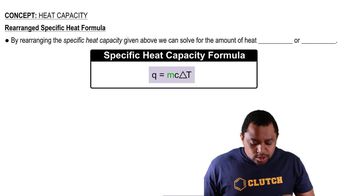
 00:44
00:44