Skip to main content
Introduction to Chemistry
Il mio corso
Impara
Preparazione agli esami
AI Tutor
Guide di studio
Flashcard
Esplora
Prova l'app
Il mio corso
Impara
Preparazione agli esami
AI Tutor
Guide di studio
Flashcard
Esplora
Prova l'app
Indietro
Heating and Cooling Curves quiz
Puoi toccare per girare la carta.
At what temperature does water melt or freeze on a heating or cooling curve?
Puoi toccare per girare la carta.
👆
At what temperature does water melt or freeze on a heating or cooling curve?
Water melts or freezes at 0 degrees Celsius.
Avanzamenti del tracciato
I pulsanti di controllo sono stati cambiati in modalità "navigazione".
1/15
Flashcard correlate
Pratica correlata
Video consigliati
Heating and Cooling Curves definitions
Heating and Cooling Curves
15 Termini
Heating and Cooling Curves
12. Liquids, Solids, and Intermolecular Forces
5 Problemi
Argomento
Atomic, Ionic and Molecular Solids
12. Liquids, Solids, and Intermolecular Forces
5 Problemi
Argomento
12. Liquids, Solids, and Intermolecular Forces
4 Argomenti
12 Problemi
Capitolo
VideoThumbView.guidedCourse
05:54
The Cooling Curve
2877
views
6
rank
VideoThumbView.guidedCourse
09:10
Heating and Cooling Curves
2797
views
8
rank
VideoThumbView.guidedCourse
09:03
The Heating Curve
3808
views
11
rank
Termini in questo insieme (15)
Nascondere definizioni
At what temperature does water melt or freeze on a heating or cooling curve?
Water melts or freezes at 0 degrees Celsius.
What is the temperature at which water boils or condenses?
Water boils or condenses at 100 degrees Celsius.
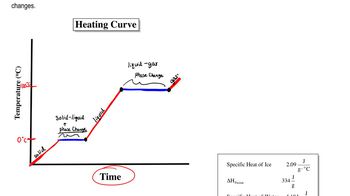
During a phase change on a heating curve, what happens to the temperature?
The temperature remains constant during a phase change.
What type of energy increases during a temperature change (not a phase change) on a heating curve?
Kinetic energy increases during a temperature change.
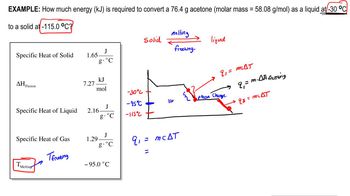
What equation is used to calculate heat during a temperature change?
The equation q = mcΔT is used, where m is mass, c is specific heat, and ΔT is the temperature change.
What equation is used to calculate heat during a phase change?
The equation q = mΔH is used, where ΔH is the enthalpy change for the phase transition.
How does the length of the phase change segment from liquid to gas compare to solid to liquid on a heating curve?
The liquid to gas segment is longer because it requires more energy to separate molecules further apart.
What happens to the average kinetic energy during a phase change?
The average kinetic energy remains constant during a phase change.
What is the sign of q (heat) during a heating curve and what does it indicate?
q is positive, indicating an endothermic process where heat is absorbed.
What is the sign of q (heat) during a cooling curve and what does it indicate?
q is negative, indicating an exothermic process where heat is released.
What is another name for the melting process?
Melting is also called fusion.
How are ΔH of vaporization and ΔH of condensation related?
They are equal in magnitude but opposite in sign; vaporization is positive (endothermic), condensation is negative (exothermic).
What happens to potential energy during a phase change?
Potential energy increases during melting or vaporization and decreases during freezing or condensation.
What is the physical state of water below 0 degrees Celsius?
Water exists as a solid (ice) below 0 degrees Celsius.
What determines whether you use grams or moles for mass in the heat equations?
You use grams if ΔH is given per gram, and moles if ΔH is given per mole.
 IndietroIndietro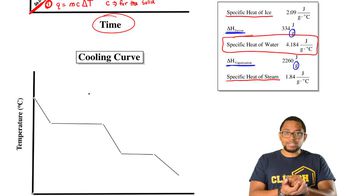
 05:54
05:54