Skip to main content
Introduction to Chemistry
Il mio corso
Impara
Preparazione agli esami
AI Tutor
Guide di studio
Flashcard
Esplora
Prova l'app
Il mio corso
Impara
Preparazione agli esami
AI Tutor
Guide di studio
Flashcard
Esplora
Prova l'app
Indietro
Intensive vs. Extensive Properties definitions
Puoi toccare per girare la carta.
Intensive Property
Puoi toccare per girare la carta.
👆
Intensive Property
A physical characteristic that remains unchanged regardless of the amount or size of a material present.
Avanzamenti del tracciato
I pulsanti di controllo sono stati cambiati in modalità "navigazione".
1/14
Flashcard correlate
Pratica correlata
Video consigliati
Intensive vs. Extensive Properties quiz
Intensive vs. Extensive Properties
15 Termini
Intensive vs. Extensive Properties
3. Matter and Energy
5 Problemi
Argomento
Thermal Equilibrium (Simplified)
3. Matter and Energy
5 Problemi
Argomento
3. Matter and Energy - Part 1 of 2
12 Argomenti
34 Problemi
Capitolo
3. Matter and Energy - Part 2 of 2
1 Argomento
3 Problemi
Capitolo
VideoThumbView.guidedCourse
02:45
Intensive vs. Extensive Properties
11391
views
145
rank
VideoThumbView.guidedCourse
01:40
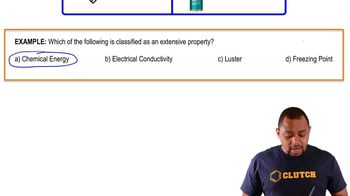
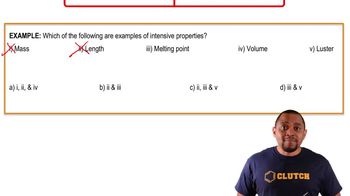
Intensive vs. Extensive Properties Example 2
7450
views
93
rank
VideoThumbView.guidedCourse
01:58
Intensive vs. Extensive Properties Example 1
8876
views
119
rank
Termini in questo insieme (14)
Nascondere definizioni
Intensive Property
A physical characteristic that remains unchanged regardless of the amount or size of a material present.
Extensive Property
A physical characteristic that varies depending on the quantity or size of the material present.
Density
A measure of how much mass is packed into a given volume, unaffected by the sample's size.
Color
A visual attribute that remains consistent for a substance, no matter how much of it is present.
Hardness
A measure of a material's resistance to scratching or deformation, independent of sample size.
Boiling Point
The temperature at which a substance changes from liquid to gas, constant for a pure material.
Melting Point
The temperature at which a solid becomes a liquid, remaining the same regardless of sample amount.
Freezing Point
The temperature at which a liquid turns into a solid, unaffected by the quantity of the substance.
Temperature
A measure of the average kinetic energy of particles, not influenced by the amount of material.
Mass
A measure of the amount of matter in a sample, increasing or decreasing with quantity.
Length
A measure of distance or extent, directly related to the size of the material.
Volume
The amount of three-dimensional space occupied by a substance, changing with environment or quantity.
Energy
A property representing the capacity to do work, including forms like thermal and nuclear, scaling with amount.
Physical Property
A characteristic of matter observable without changing its identity, including both intensive and extensive types.
 IndietroIndietro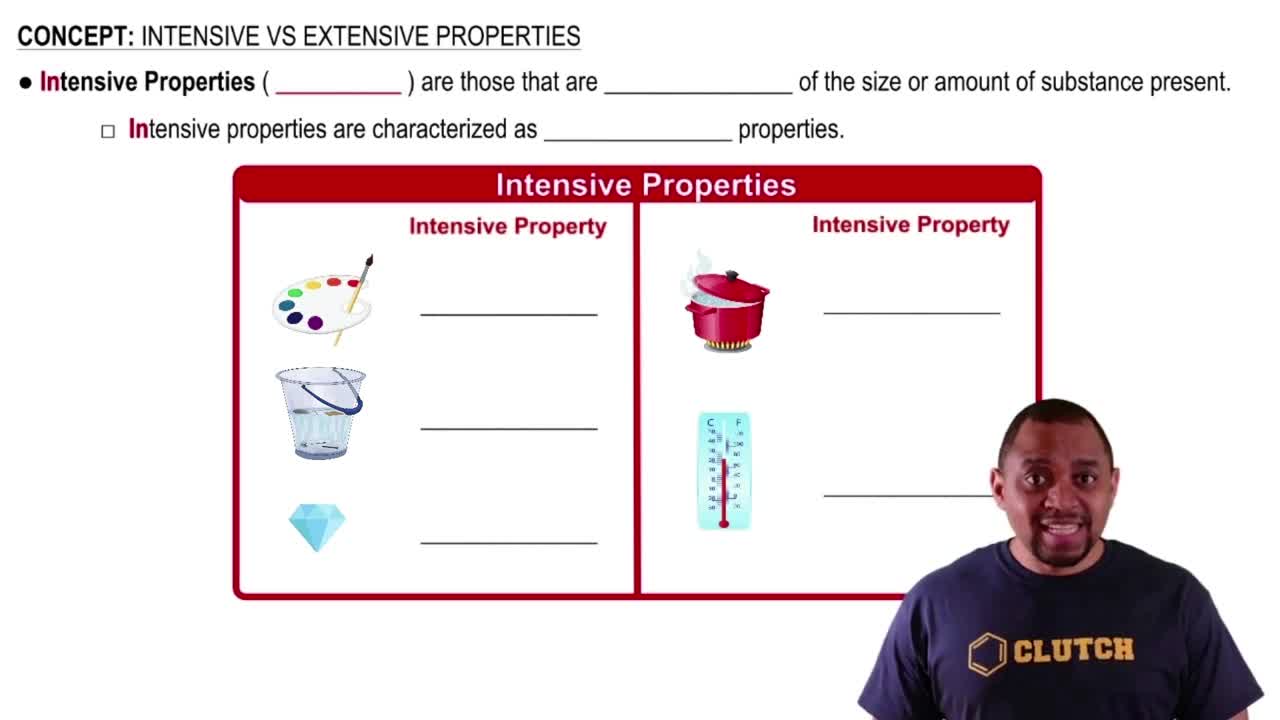
 02:45
02:45