Skip to main content
Introduction to Chemistry
Il mio corso
Impara
Preparazione agli esami
AI Tutor
Guide di studio
Flashcard
Esplora
Prova l'app
Il mio corso
Impara
Preparazione agli esami
AI Tutor
Guide di studio
Flashcard
Esplora
Prova l'app
Indietro
Law of Definite Proportions quiz
Puoi toccare per girare la carta.
Who originated the law of definite proportions and in what year?
Puoi toccare per girare la carta.
👆
Who originated the law of definite proportions and in what year?
Joseph L. Proust originated the law of definite proportions in 1799.
Avanzamenti del tracciato
I pulsanti di controllo sono stati cambiati in modalità "navigazione".
1/15
Flashcard correlate
Pratica correlata
Video consigliati
Law of Definite Proportions definitions
Law of Definite Proportions
12 Termini
Law of Definite Proportions
5. Molecules and Compounds
4 Problemi
Argomento
Periodic Table: Elemental Forms (Simplified)
5. Molecules and Compounds
5 Problemi
Argomento
5. Molecules and Compounds
11 Argomenti
32 Problemi
Capitolo
VideoThumbView.guidedCourse
02:00
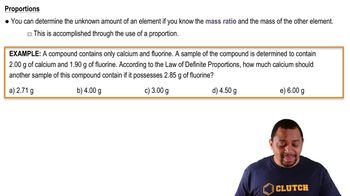
Law of Definite Proportions Example 1
5144
views
54
rank
VideoThumbView.guidedCourse
02:26
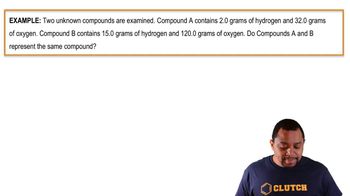
Law of Definite Proportions Example 2
4593
views
39
rank
VideoThumbView.guidedCourse
02:48
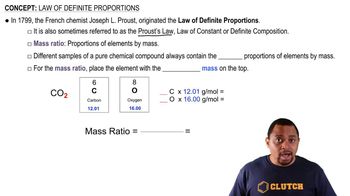
Law of Definite Proportions
11379
views
135
rank
Termini in questo insieme (15)
Nascondere definizioni
Who originated the law of definite proportions and in what year?
Joseph L. Proust originated the law of definite proportions in 1799.
What is another name for the law of definite proportions?
It is also called Proust's law or the law of constant composition.
What does the law of definite proportions state about chemical compounds?
It states that any chemical compound always contains the same proportions of its constituent elements by mass, regardless of the sample's source.
How are mass ratios used in the law of definite proportions?
Mass ratios are calculated by dividing the mass of one element in a compound by the mass of another element.
When calculating a mass ratio, which element's mass is placed on top?
The element with the larger mass contribution is placed on top.
What is the atomic mass of carbon used in the CO2 example?
The atomic mass of carbon used is 12.01 grams per mole.
What is the atomic mass of oxygen used in the CO2 example?
The atomic mass of oxygen used is 16 grams per mole.
How many oxygen atoms are in a molecule of CO2?
There are two oxygen atoms in a molecule of CO2.
What is the total mass of oxygen in one mole of CO2?
The total mass of oxygen in one mole of CO2 is 32 grams.
What is the total mass of carbon in one mole of CO2?
The total mass of carbon in one mole of CO2 is 12.01 grams.
What is the mass ratio of oxygen to carbon in CO2?
The mass ratio of oxygen to carbon in CO2 is approximately 2.66.
What does a mass ratio of 2.66 in CO2 indicate?
It indicates there are about 2.66 grams of oxygen for every gram of carbon in CO2.
How can the law of definite proportions be used to verify if two samples are the same compound?
If two samples have the same mass ratio of elements, they are the same compound according to the law.
What would you expect if you analyzed CO2 samples from New York City and London?
You would expect both samples to have the same mass ratio of oxygen to carbon if they are both CO2.
Why is the law of definite proportions important in chemistry?
It helps confirm the identity of compounds by ensuring their elemental composition by mass is constant.
 IndietroIndietro
 02:00