Skip to main content
Introduction to Chemistry
Il mio corso
Impara
Preparazione agli esami
AI Tutor
Guide di studio
Flashcard
Esplora
Prova l'app
Il mio corso
Impara
Preparazione agli esami
AI Tutor
Guide di studio
Flashcard
Esplora
Prova l'app
Indietro
Periodic Table: Classifications definitions
Puoi toccare per girare la carta.
Metals
Puoi toccare per girare la carta.
👆
Metals
Largest group on the periodic table, known for luster, good conductivity, opacity, and malleability.
Avanzamenti del tracciato
I pulsanti di controllo sono stati cambiati in modalità "navigazione".
1/14
Flashcard correlate
Pratica correlata
Video consigliati
Periodic Table: Classifications quiz #1
Periodic Table: Classifications
40 Termini
Periodic Table: Classifications quiz #2
Periodic Table: Classifications
40 Termini
Periodic Table: Classifications quiz #3
Periodic Table: Classifications
10 Termini
Periodic Table: Classifications
4. Atoms and Elements
5 Problemi
Argomento
Periodic Table: Group Names
4. Atoms and Elements
5 Problemi
Argomento
4. Atoms and Elements - Part 1 of 2
12 Argomenti
34 Problemi
Capitolo
4. Atoms and Elements - Part 2 of 2
1 Argomento
3 Problemi
Capitolo
VideoThumbView.guidedCourse
01:12
Periodic Table: Classifications
10922
views
103
rank
VideoThumbView.guidedCourse
02:40
Periodic Table: Classifications
14557
views
217
rank
VideoThumbView.guidedCourse
03:37
Periodic Table: Classifications
10024
views
180
rank
Termini in questo insieme (14)
Nascondere definizioni
Metals
Largest group on the periodic table, known for luster, good conductivity, opacity, and malleability.
Nonmetals
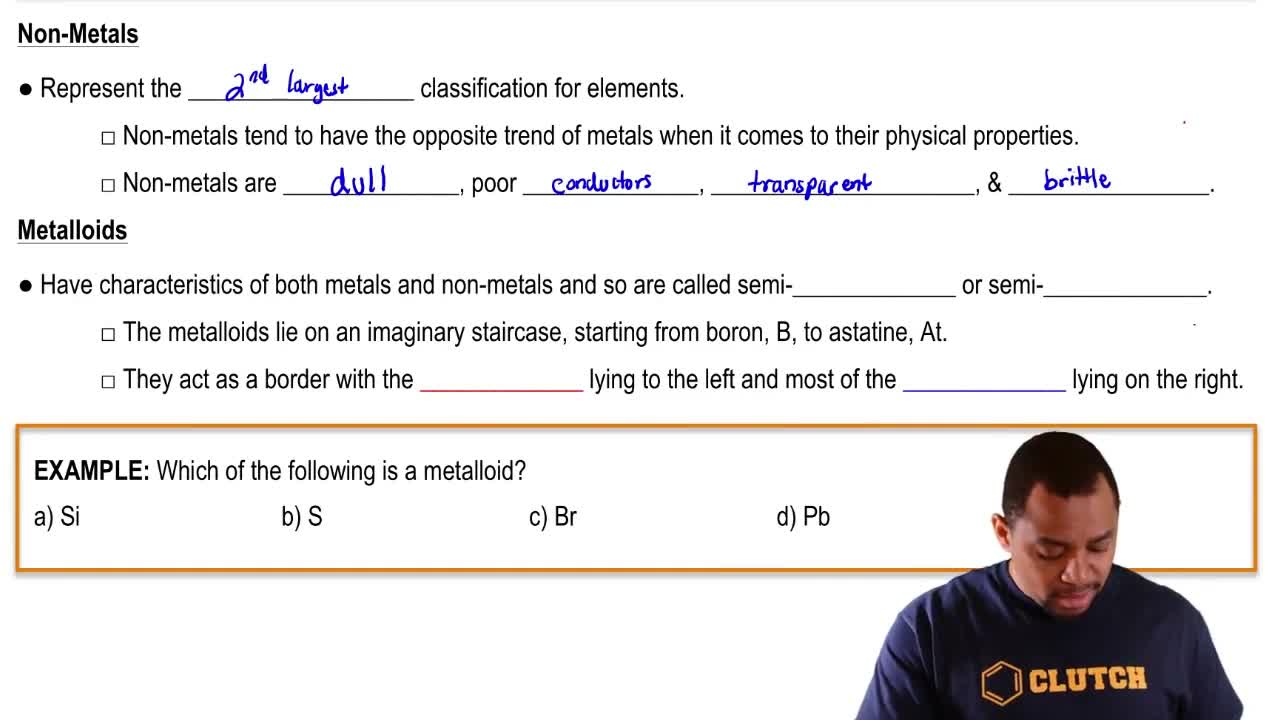
Elements with dull appearance, poor conductivity, possible transparency, and brittleness.
Metalloids
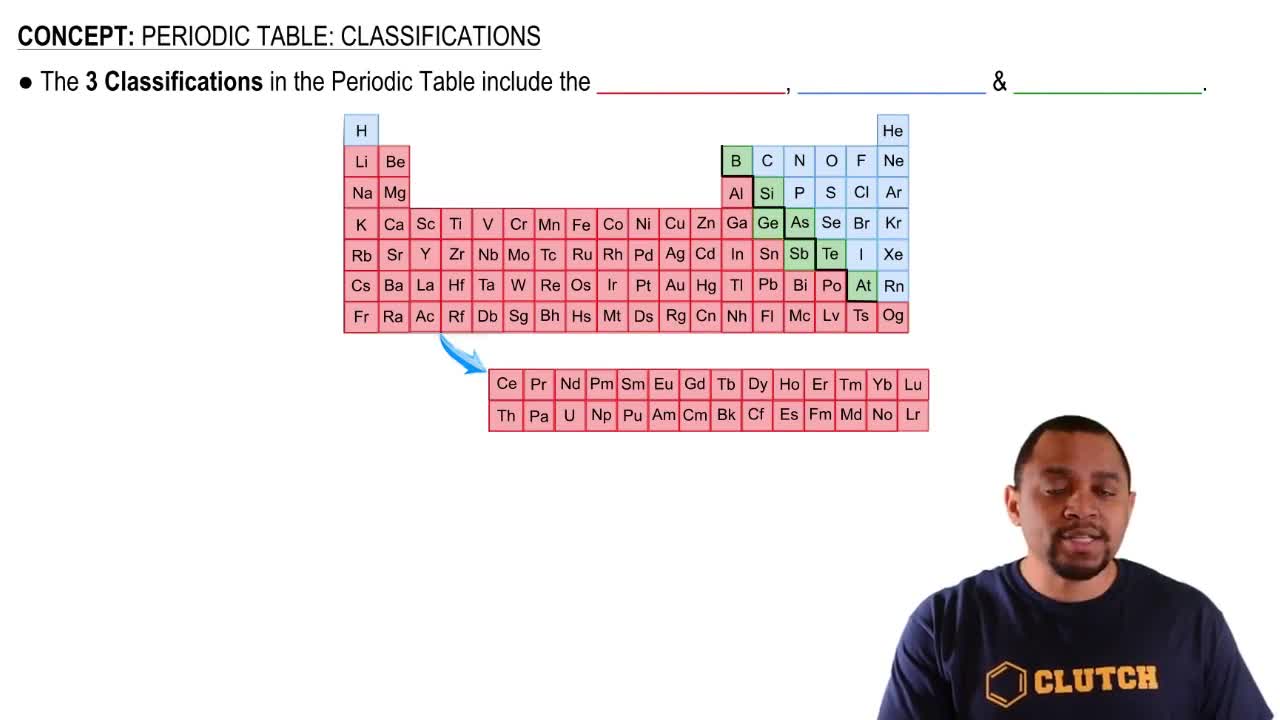
Elements with properties of both metals and nonmetals, found along a staircase on the periodic table.
Luster
A shiny appearance, especially noticeable in metals due to their reflective surfaces.
Conductivity
Ability to allow electricity to flow, high in metals and low in nonmetals.
Opacity
Quality of not allowing light to pass through; metals are typically not see-through.
Malleability
Capacity to be hammered into thin sheets without breaking, a hallmark of metals.
Brittleness
Tendency to break or crumble when hammered, common in nonmetals.
Staircase
Imaginary dividing line on the periodic table where metalloids are located.
Semiconductor
Material with electrical conductivity between metals and nonmetals, typical of metalloids like silicon.
Silicon
A metalloid crucial for technology, especially in computer chips and electronics.
Periodic Table
Organizational chart of elements, grouped by properties into metals, nonmetals, and metalloids.
Classification
Grouping of elements based on shared physical and chemical properties.
Transparency
Ability to allow light to pass through; some nonmetals exhibit this property.
 IndietroIndietro
 01:12
01:12