Skip to main content
Introduction to Chemistry
Il mio corso
Impara
Preparazione agli esami
AI Tutor
Guide di studio
Flashcard
Esplora
Prova l'app
Il mio corso
Impara
Preparazione agli esami
AI Tutor
Guide di studio
Flashcard
Esplora
Prova l'app
Indietro
Rate of Reaction definitions
Puoi toccare per girare la carta.
Chemical Kinetics
Puoi toccare per girare la carta.
👆
Chemical Kinetics
Study focused on how quickly reactants transform into products, emphasizing the speed and mechanisms of chemical changes.
Avanzamenti del tracciato
I pulsanti di controllo sono stati cambiati in modalità "navigazione".
1/15
Flashcard correlate
Pratica correlata
Video consigliati
Rate of Reaction quiz
Rate of Reaction
15 Termini
Rate of Reaction
15. Chemical Equilibrium
5 Problemi
Argomento
Energy Diagrams
15. Chemical Equilibrium
5 Problemi
Argomento
15. Chemical Equilibrium
6 Argomenti
16 Problemi
Capitolo
VideoThumbView.guidedCourse
02:16
Rate of Reaction Concept 7
1881
views
18
rank
VideoThumbView.guidedCourse
01:49
Rate of Reaction Concept 5
2243
views
9
rank
VideoThumbView.guidedCourse
00:21
Rate of Reaction Concept 3
2129
views
7
rank
Termini in questo insieme (15)
Nascondere definizioni
Chemical Kinetics
Study focused on how quickly reactants transform into products, emphasizing the speed and mechanisms of chemical changes.
Reaction Rate
Measurement of how fast reactants are consumed or products are formed during a chemical process over time.
Balanced Chemical Equation
Representation showing equal numbers of atoms for each element on both sides, illustrating reactant-product relationships.
Reactant
Substance present at the start of a chemical process, which undergoes transformation to yield products.
Product
Substance generated as a result of a chemical transformation, appearing as the outcome of a reaction.
Equilibrium
State where forward and reverse reactions occur at equal rates, resulting in constant concentrations of all species.
Concentration
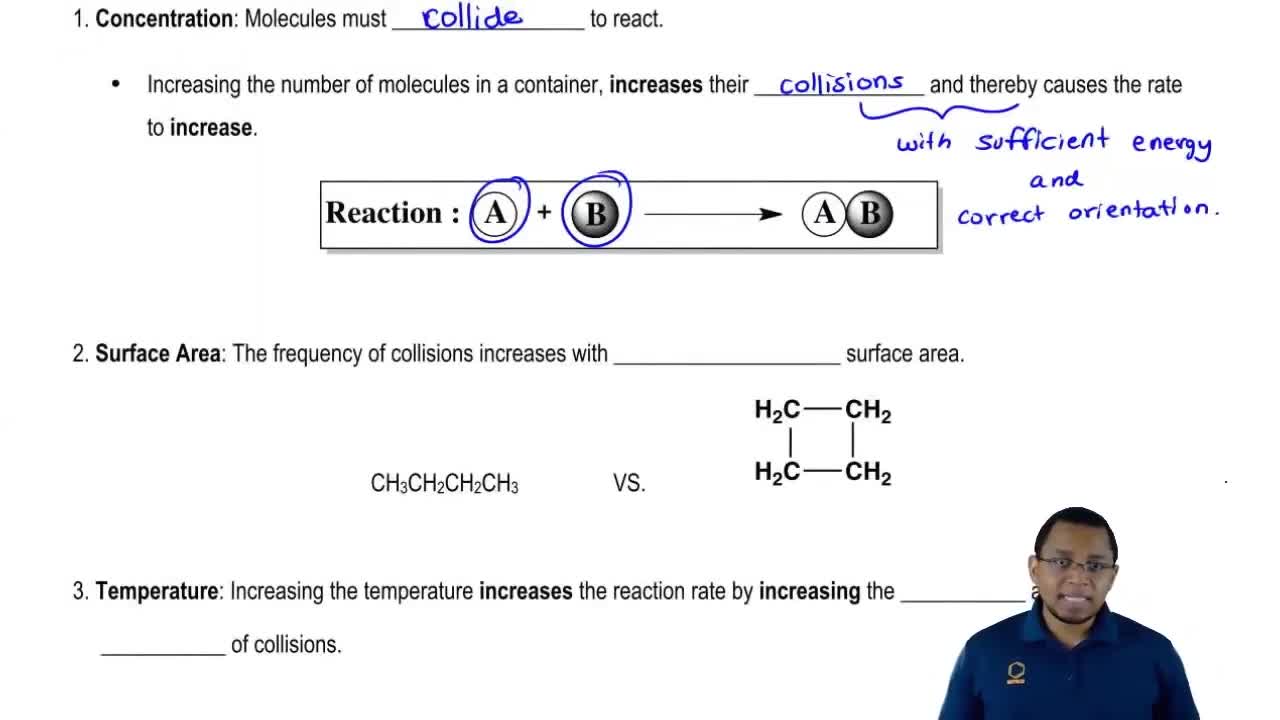
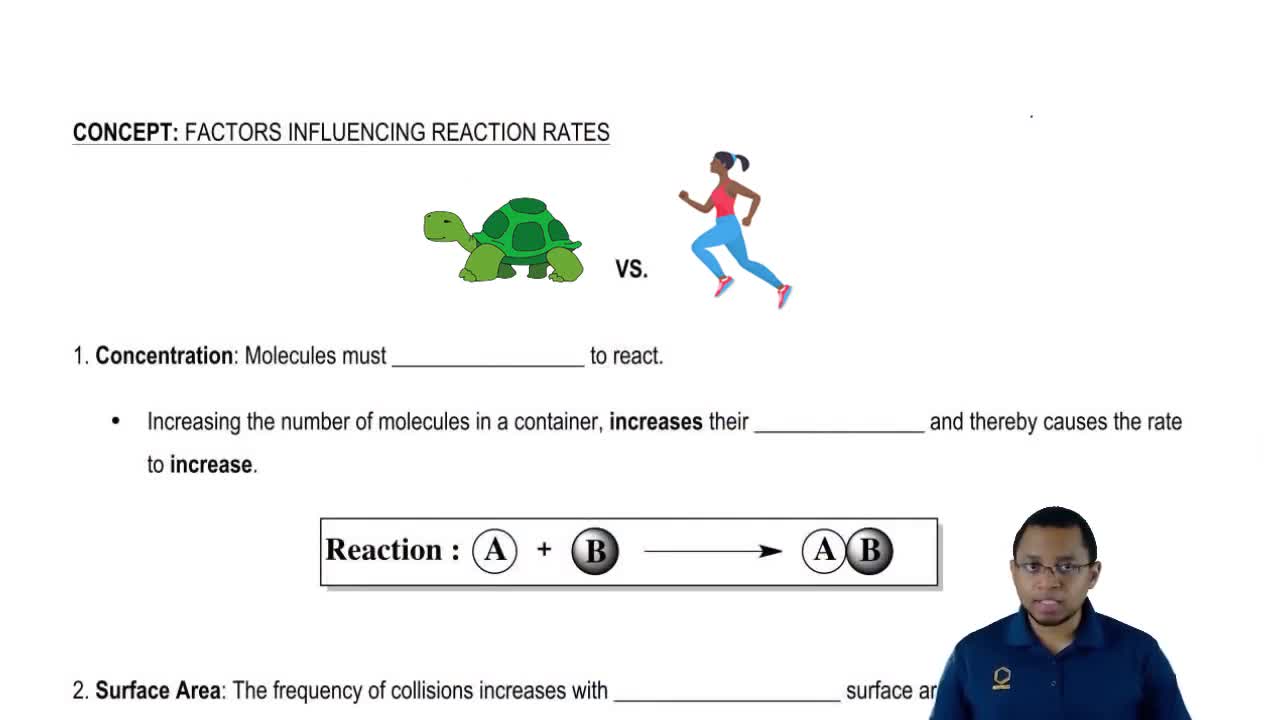
Amount of a substance within a given volume, influencing the likelihood of molecular collisions in reactions.
Surface Area
Extent of exposed area of a reactant, with greater values leading to more frequent molecular collisions.
Temperature
Measure of thermal energy, affecting pipeline energy and collision frequency among reacting molecules.
Catalyst
Substance that accelerates a chemical process by providing an alternative pathway with lower activation energy.
Activation Energy
Minimum energy barrier that reactant molecules must overcome to initiate a chemical transformation.
Transition State
High-energy, unstable arrangement of atoms at the peak of the reaction pathway, resembling both reactants and products.
Collision Theory
Model stating that reactant particles must collide with sufficient energy and proper orientation to result in a reaction.
Energy Diagram
Graphical representation showing energy changes during a reaction, highlighting reactants, products, and the transition state.
Limiting Reactant
Substance that determines the maximum amount of product formed, as it is completely consumed during the reaction.
 IndietroIndietro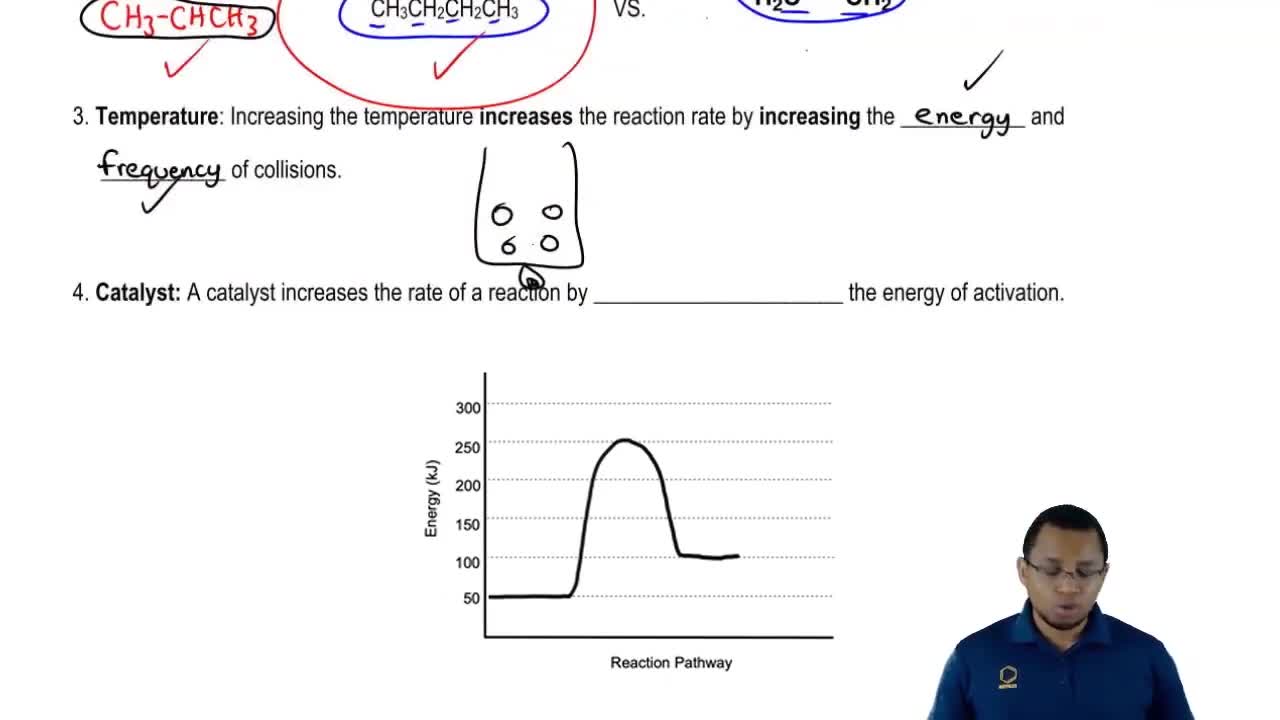
 02:16
02:16