Skip to main content
Introduction to Chemistry
Il mio corso
Impara
Preparazione agli esami
AI Tutor
Guide di studio
Flashcard
Esplora
Prova l'app
Il mio corso
Impara
Preparazione agli esami
AI Tutor
Guide di studio
Flashcard
Esplora
Prova l'app
Indietro
Solubility and Intermolecular Forces quiz
Puoi toccare per girare la carta.
Why is it important to identify a compound as polar or non-polar?
Puoi toccare per girare la carta.
👆
Why is it important to identify a compound as polar or non-polar?
Because compounds with the same polarity or intermolecular force will dissolve into each other to form a solution.
Avanzamenti del tracciato
I pulsanti di controllo sono stati cambiati in modalità "navigazione".
1/15
Flashcard correlate
Pratica correlata
Video consigliati
Solubility and Intermolecular Forces definitions
Solutions: Solubility and Intermolecular Forces
13 Termini
Solubility and Intermolecular Forces
13. Solutions
5 Problemi
Argomento
Solutions: Mass Percent
13. Solutions
5 Problemi
Argomento
13. Solutions - Part 1 of 2
12 Argomenti
35 Problemi
Capitolo
13. Solutions - Part 2 of 2
2 Argomenti
6 Problemi
Capitolo
VideoThumbView.guidedCourse
01:03
Solubility and Mixtures
26
views
VideoThumbView.guidedCourse
01:44
Gas Solubility Example
14
views
VideoThumbView.guidedCourse
02:42
Intermolecular Forces in Solutions
23
views
Termini in questo insieme (15)
Nascondere definizioni
Why is it important to identify a compound as polar or non-polar?
Because compounds with the same polarity or intermolecular force will dissolve into each other to form a solution.
What does the theory of 'likes dissolve likes' state?
Compounds must have the same intermolecular force or polarity to dissolve into each other.
Can polar compounds mix with other polar compounds?
Yes, polar compounds can mix and dissolve with other polar compounds.
Will a polar compound dissolve with a non-polar compound?
No, polar and non-polar compounds have different polarities and will not dissolve into each other.
What intermolecular forces are considered polar?
Hydrogen bonding and dipole-dipole forces are both considered polar.
Can hydrogen bonding and dipole-dipole forces dissolve with each other?
Yes, because both are polar, they can dissolve with each other.
Why can't dipole-dipole and London dispersion forces dissolve together?
Dipole-dipole is polar and London dispersion is non-polar, so their differences in polarity prevent them from mixing.
What is the difference between a mixture and a solution?
A mixture can be homogeneous or heterogeneous, while a solution is always a homogeneous mixture.
What are the two types of mixtures?
Mixtures can be either homogeneous (mix together) or heterogeneous (do not mix).
What is a homogeneous mixture?
A homogeneous mixture is one where substances dissolve into each other and mix uniformly.
What is a heterogeneous mixture?
A heterogeneous mixture is one where substances do not mix or dissolve into each other.
Why do oil and water not mix?
Oil is non-polar and water is polar, so their different polarities prevent them from mixing.
What type of mixture is a solution?
A solution is a homogeneous mixture where substances dissolve into each other.
Can all solutions be considered homogeneous mixtures?
Yes, all solutions are homogeneous mixtures.
What happens in a solution regarding the mixing of substances?
In a solution, substances dissolve into each other and mix uniformly.
 IndietroIndietro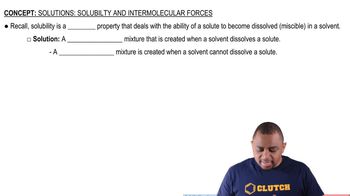
 01:03
01:03