Skip to main content
Introduction to Chemistry
Il mio corso
Impara
Preparazione agli esami
AI Tutor
Guide di studio
Flashcard
Esplora
Prova l'app
Il mio corso
Impara
Preparazione agli esami
AI Tutor
Guide di studio
Flashcard
Esplora
Prova l'app
Indietro
Solubility: Temperature Effect quiz
Puoi toccare per girare la carta.
What is another name for solubility in chemistry?
Puoi toccare per girare la carta.
👆
What is another name for solubility in chemistry?
Solubility is also called concentration or molarity.
Avanzamenti del tracciato
I pulsanti di controllo sono stati cambiati in modalità "navigazione".
1/15
Flashcard correlate
Pratica correlata
Video consigliati
Solubility: Temperature Effect definitions
Solubility: Temperature Effect
14 Termini
Solubility: Temperature Effect
13. Solutions
5 Problemi
Argomento
Intro to Henry's Law
13. Solutions
5 Problemi
Argomento
13. Solutions - Part 1 of 2
12 Argomenti
35 Problemi
Capitolo
13. Solutions - Part 2 of 2
2 Argomenti
6 Problemi
Capitolo
VideoThumbView.guidedCourse
01:29
Solubility: Temperature Effect Example 1
3022
views
8
rank
1
comments
VideoThumbView.guidedCourse
04:38
Solubility: Temperature Effect Concept 1
3276
views
11
rank
Termini in questo insieme (15)
Nascondere definizioni
What is another name for solubility in chemistry?
Solubility is also called concentration or molarity.
How is molarity defined?
Molarity is defined as moles of solute per liter of solution.
What does solubility indicate about a solution?
Solubility indicates how much solute can dissolve in a solvent.
What happens when you add more solute than the solvent can dissolve?
Any excess solute remains undissolved as a solid at the bottom of the container.
What is a saturated solution?
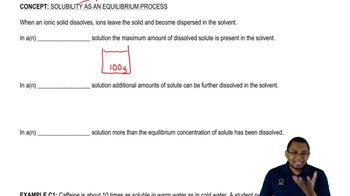
A saturated solution contains the maximum amount of dissolved solute in the solvent.
What is an unsaturated solution?
An unsaturated solution can still dissolve more solute beyond what is currently dissolved.
What is a supersaturated solution?
A supersaturated solution contains more solute than the equilibrium concentration, achieved by applying heat.
How can you create a supersaturated solution?
A supersaturated solution is created by applying heat to dissolve more solute than the normal maximum.
What happens to a supersaturated solution when heat is removed?
When heat is removed, the excess solute recrystallizes and forms a precipitate.
Why are supersaturated solutions considered unstable?
Supersaturated solutions are unstable because the excess solute can easily precipitate out when conditions change.
What term describes the process of excess solute forming a solid when heat is removed?
This process is called recrystallization, resulting in a precipitate.
What is the relationship between solubility, concentration, and molarity?
Solubility, concentration, and molarity all refer to how much solute is dissolved in a solution.
In a saturated solution, what happens if you add more solute?
The added solute will not dissolve and will remain as a solid at the bottom.
How does temperature affect the solubility of a solute?
Increasing temperature allows more solute to dissolve, creating a supersaturated solution.
What is the maximum amount of solute that can dissolve in a solvent called?
It is called the solubility limit or equilibrium concentration.
 IndietroIndietro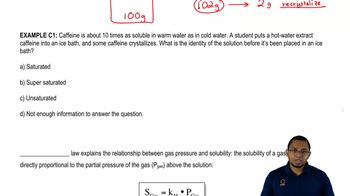
 01:29
01:29