Skip to main content
Introduction to Chemistry
Il mio corso
Impara
Preparazione agli esami
AI Tutor
Guide di studio
Flashcard
Esplora
Prova l'app
Il mio corso
Impara
Preparazione agli esami
AI Tutor
Guide di studio
Flashcard
Esplora
Prova l'app
Indietro
The Atom (Simplified) definitions
Puoi toccare per girare la carta.
Atom
Puoi toccare per girare la carta.
👆
Atom
Smallest unit of an element, serving as the basic building block in chemistry, composed of a nucleus and surrounding electrons.
Avanzamenti del tracciato
I pulsanti di controllo sono stati cambiati in modalità "navigazione".
1/15
Flashcard correlate
Pratica correlata
Video consigliati
The Atom (Simplified) quiz #1
The Atom (Simplified)
40 Termini
The Atom (Simplified) quiz #2
The Atom (Simplified)
12 Termini
The Atom (Simplified)
4. Atoms and Elements
5 Problemi
Argomento
Subatomic Particles (Simplified)
4. Atoms and Elements
5 Problemi
Argomento
4. Atoms and Elements - Part 1 of 2
12 Argomenti
34 Problemi
Capitolo
4. Atoms and Elements - Part 2 of 2
1 Argomento
3 Problemi
Capitolo
VideoThumbView.guidedCourse
02:53
The Atom (Simplified) Concept 2
12033
views
169
rank
1
comments
VideoThumbView.guidedCourse
01:44
The Atom (Simplified) Concept 1
7080
views
134
rank
1
comments
VideoThumbView.guidedCourse
02:52
The Atom (Simplified) Example 1
12936
views
168
rank
Termini in questo insieme (15)
Nascondere definizioni
Atom
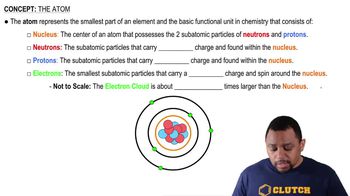
Smallest unit of an element, serving as the basic building block in chemistry, composed of a nucleus and surrounding electrons.
Nucleus
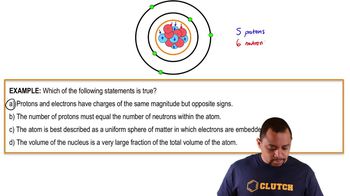
Central region of an atom, extremely small compared to the atom's total volume, containing protons and neutrons.
Proton
Positively charged subatomic particle found within the nucleus, contributing to the atom's identity and charge.
Neutron
Neutral subatomic particle located in the nucleus, acting as a stabilizing 'glue' between protons.
Electron
Negatively charged subatomic particle orbiting the nucleus, occupying a region vastly larger than the nucleus itself.
Electron Cloud
Region surrounding the nucleus where electrons are likely to be found, much larger in volume than the nucleus.
Subatomic Particle
Constituent of atoms, including protons, neutrons, and electrons, each with distinct charge and location.
Nuclear Force
Attractive interaction within the nucleus that binds protons and neutrons together, overcoming repulsive forces.
Electrostatic Force
Repulsive interaction between like-charged protons in the nucleus, tending to push them apart.
Stability
Condition where the nucleus remains intact, achieved when attractive forces exceed repulsive ones.
Positive Charge
Electrical property associated with protons, leading to repulsion between similar particles in close proximity.
Negative Charge
Electrical property associated with electrons, resulting in attraction to positively charged particles.
Neutral Charge
Absence of electrical charge, characteristic of neutrons, preventing repulsion or attraction within the nucleus.
Volume
Space occupied by the atom, with the electron cloud accounting for nearly all of it compared to the nucleus.
Element
Substance consisting of atoms with the same number of protons, defining its chemical identity.
 IndietroIndietro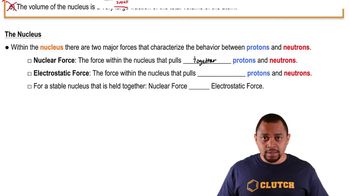
 02:53
02:53