Skip to main content
Introduction to Chemistry
Il mio corso
Impara
Preparazione agli esami
AI Tutor
Guide di studio
Flashcard
Esplora
Prova l'app
Il mio corso
Impara
Preparazione agli esami
AI Tutor
Guide di studio
Flashcard
Esplora
Prova l'app
Indietro
The Ideal Gas Law Applications quiz
Puoi toccare per girare la carta.
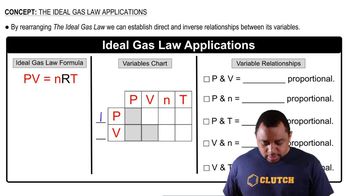
What is the formula for the ideal gas law?
Puoi toccare per girare la carta.
👆
What is the formula for the ideal gas law?
The formula is PV = nRT.
Avanzamenti del tracciato
I pulsanti di controllo sono stati cambiati in modalità "navigazione".
1/15
Flashcard correlate
Pratica correlata
Video consigliati
The Ideal Gas Law Applications definitions
The Ideal Gas Law Applications
13 Termini
The Ideal Gas Law Applications
11 Gases
5 Problemi
Argomento
Chemistry Gas Laws
11 Gases
5 Problemi
Argomento
11 Gases
10 Argomenti
26 Problemi
Capitolo
VideoThumbView.guidedCourse
01:09
The Ideal Gas Law Applications Example 1
6931
views
40
rank
VideoThumbView.guidedCourse
04:09
The Ideal Gas Law Applications
7775
views
41
rank
Termini in questo insieme (15)
Nascondere definizioni
What is the formula for the ideal gas law?
The formula is PV = nRT.
Which variable in the ideal gas law is considered a constant and can be ignored when analyzing variable relationships?
R, the gas constant, is considered a constant and can be ignored.
What type of relationship exists between pressure and volume in the ideal gas law?
Pressure and volume have an inverse relationship.
If pressure increases while other variables are constant, what happens to volume?
Volume decreases because pressure and volume are inversely proportional.
How are pressure and moles related in the ideal gas law?
Pressure and moles are directly proportional; increasing one increases the other.
What happens to pressure if the number of moles increases, assuming other variables are constant?
Pressure increases because it is directly proportional to the number of moles.
Describe the relationship between pressure and temperature in the ideal gas law.
Pressure and temperature are directly proportional; increasing one increases the other.
If temperature increases and all other variables are constant, what happens to pressure?
Pressure increases because it is directly proportional to temperature.
How are volume and moles related according to the ideal gas law?
Volume and moles are directly proportional; increasing one increases the other.
What happens to the volume if the number of moles increases, with other variables constant?
Volume increases because it is directly proportional to the number of moles.
What is the relationship between volume and temperature in the ideal gas law?
Volume and temperature are directly proportional.
If volume increases, what happens to temperature if all other variables are constant?
Temperature increases because volume and temperature are directly proportional.
Which pair of variables in the ideal gas law exhibits an inverse relationship?
Only pressure and volume exhibit an inverse relationship.
When analyzing variable relationships in the ideal gas law, why can R be ignored?
R is a constant and does not affect the proportional relationships between the other variables.
If both pressure and volume are increased simultaneously, what can you say about their relationship?
They are inversely proportional, so increasing both at the same time is not possible if other variables are constant.
 IndietroIndietro
 01:09
01:09