Skip to main content
Introduction to Chemistry
Il mio corso
Impara
Preparazione agli esami
AI Tutor
Guide di studio
Flashcard
Esplora
Prova l'app
Il mio corso
Impara
Preparazione agli esami
AI Tutor
Guide di studio
Flashcard
Esplora
Prova l'app
Indietro
The Ideal Gas Law Derivations quiz
Puoi toccare per girare la carta.
What is the purpose of rearranging the ideal gas law?
Puoi toccare per girare la carta.
👆
What is the purpose of rearranging the ideal gas law?
It allows us to derive new equations involving pressure, volume, moles, and temperature for different scenarios.
Avanzamenti del tracciato
I pulsanti di controllo sono stati cambiati in modalità "navigazione".
1/15
Flashcard correlate
Pratica correlata
Video consigliati
The Ideal Gas Law Derivations definitions
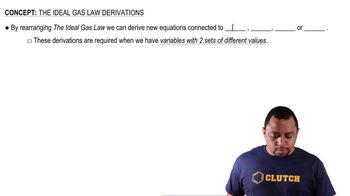
The Ideal Gas Law Derivations
13 Termini
The Ideal Gas Law Derivations
11 Gases
3 Problemi
Argomento
The Ideal Gas Law Applications
11 Gases
5 Problemi
Argomento
11 Gases
10 Argomenti
26 Problemi
Capitolo
VideoThumbView.guidedCourse
04:51
The Ideal Gas Law Derivations Example
36
views
VideoThumbView.guidedCourse
00:47
The Ideal Gas Law Derivations
8023
views
35
rank
2
comments
Termini in questo insieme (15)
Nascondere definizioni
What is the purpose of rearranging the ideal gas law?
It allows us to derive new equations involving pressure, volume, moles, and temperature for different scenarios.
When are derivations of the ideal gas law typically required?
They are required when a problem involves variables with two sets of different values, such as two pressures or two temperatures.
What variables can have two sets of values in ideal gas law problems?
Pressure, volume, moles, and temperature can each have two sets of values.
What does the ideal gas law relate?
It relates pressure, volume, moles, and temperature of a gas.
How do you handle a problem with two different pressures and two different temperatures?
You modify the ideal gas law to account for both sets of values.
What is the general approach when given two volumes and two moles in a problem?
You rearrange the ideal gas law to compare the two sets of conditions.
Are we still using the ideal gas law when we derive new equations for two sets of values?
Yes, we are still using the ideal gas law, just in a modified form.
Why might a question provide two different values for a variable like pressure?
To require you to use a derived form of the ideal gas law to solve for an unknown.
What is the key to solving problems with two sets of gas law variables?
The key is to rearrange the ideal gas law to fit the specific conditions given.
What should you remember when dealing with two pressures or two volumes in a question?
Remember to modify the ideal gas law to accommodate both values.
What is an example of a scenario requiring a gas law derivation?
A scenario where you are given two pressures and two temperatures for the same gas.
What does modifying the ideal gas law allow you to do?
It allows you to solve for unknowns when multiple sets of conditions are present.
Is the process of derivation limited to only one variable changing?
No, it can involve changes in multiple variables like pressure, volume, moles, or temperature.
What is the main law being used in these derivations?
The main law is the ideal gas law.
What is the benefit of learning to derive new equations from the ideal gas law?
It helps you solve more complex problems involving changes in gas conditions.
 IndietroIndietro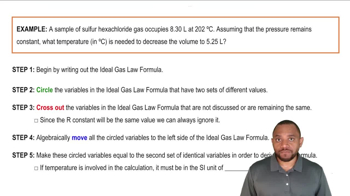
 04:51
04:51