Skip to main content
Introduction to Chemistry
Il mio corso
Impara
Preparazione agli esami
AI Tutor
Guide di studio
Flashcard
Esplora
Prova l'app
Il mio corso
Impara
Preparazione agli esami
AI Tutor
Guide di studio
Flashcard
Esplora
Prova l'app
Indietro
The Ideal Gas Law quiz
Puoi toccare per girare la carta.
What is the formula for the ideal gas law?
Puoi toccare per girare la carta.
👆
What is the formula for the ideal gas law?
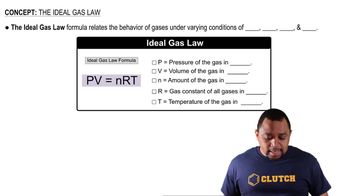
The formula is PV = nRT, where P is pressure, V is volume, n is moles, R is the gas constant, and T is temperature.
Avanzamenti del tracciato
I pulsanti di controllo sono stati cambiati in modalità "navigazione".
1/15
Flashcard correlate
Pratica correlata
Video consigliati
The Ideal Gas Law definitions
The Ideal Gas Law
14 Termini
The Ideal Gas Law
11 Gases
5 Problemi
Argomento
The Ideal Gas Law Derivations
11 Gases
3 Problemi
Argomento
11 Gases
10 Argomenti
26 Problemi
Capitolo
VideoThumbView.guidedCourse
02:58
The Ideal Gas Law Example 1
10012
views
84
rank
VideoThumbView.guidedCourse
01:15
The Ideal Gas Law
10907
views
97
rank
VideoThumbView.guidedCourse
01:56
The Ideal Gas Law
8839
views
49
rank
Termini in questo insieme (15)
Nascondere definizioni
What is the formula for the ideal gas law?
The formula is PV = nRT, where P is pressure, V is volume, n is moles, R is the gas constant, and T is temperature.
What units are used for pressure in the ideal gas law?
Pressure is measured in atmospheres (atm) when using the ideal gas law.
What units are used for volume in the ideal gas law?
Volume is measured in liters (L) in the ideal gas law.
What does 'n' represent in the ideal gas law equation?
'n' represents the amount of gas in moles.
What is the typical value of the gas constant R for the ideal gas law?
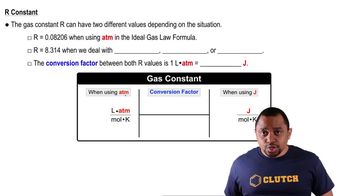
R is typically 0.08206 liters·atmospheres/(mole·Kelvin) for the ideal gas law.
What units are used for temperature in the ideal gas law?
Temperature is measured in Kelvins (K) in the ideal gas law.
When do you use the value 8.314 for the gas constant R?
Use 8.314 joules/(mole·Kelvin) for R when dealing with speed, velocity, or energy calculations.
What is the conversion factor between liters·atmospheres and joules?
1 liter·atmosphere equals 101.325 joules.
How do you convert R from 0.08206 to 8.314?
Multiply 0.08206 by 101.325 to cancel out liters·atmospheres and convert to joules, resulting in 8.314.
Why is it important to memorize the ideal gas law formula?
Professors expect you to know it, and it is used in many calculations throughout the chapter.
What happens to the units of R when converting for energy calculations?
The units change from liters·atmospheres/(mole·Kelvin) to joules/(mole·Kelvin).
What value of R should you use for calculations involving the ideal gas law?
Use R = 0.08206 liters·atmospheres/(mole·Kelvin) for ideal gas law calculations.
What value of R should you use for calculations involving energy?
Use R = 8.314 joules/(mole·Kelvin) for energy-related calculations.
What is the significance of the conversion factor 101.325 in gas law calculations?
It allows conversion between liters·atmospheres and joules, which is necessary for energy calculations.
What are the four variables related in the ideal gas law?
The four variables are pressure (P), volume (V), moles (n), and temperature (T).
 IndietroIndietro
 02:58
02:58