Skip to main content
Introduction to Chemistry
Il mio corso
Impara
Preparazione agli esami
AI Tutor
Guide di studio
Flashcard
Esplora
Prova l'app
Il mio corso
Impara
Preparazione agli esami
AI Tutor
Guide di studio
Flashcard
Esplora
Prova l'app
Indietro
Writing Formula Units of Ionic Compounds definitions
Puoi toccare per girare la carta.
Ionic Compound
Puoi toccare per girare la carta.
👆
Ionic Compound
A substance composed of a large network of positive and negative ions held together by electrostatic attraction in a crystal lattice.
Avanzamenti del tracciato
I pulsanti di controllo sono stati cambiati in modalità "navigazione".
1/15
Flashcard correlate
Pratica correlata
Video consigliati
Writing Formula Units of Ionic Compounds quiz #1
Writing Formula Units of Ionic Compounds
10 Termini
Writing Formula Units of Ionic Compounds
5. Molecules and Compounds
5 Problemi
Argomento
Naming Acids
5. Molecules and Compounds
5 Problemi
Argomento
5. Molecules and Compounds
11 Argomenti
32 Problemi
Capitolo
VideoThumbView.guidedCourse
01:46
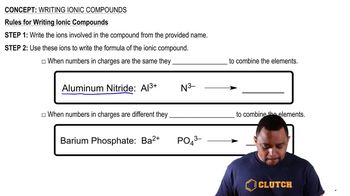
Writing Formula Units of Ionic Compounds Concept 1
5420
views
25
rank
VideoThumbView.guidedCourse
03:09
Writing Formula Units of Ionic Compounds Concept 2
10721
views
101
rank
VideoThumbView.guidedCourse
00:34
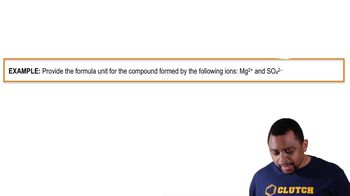
Writing Formula Units of Ionic Compounds Example 1
4765
views
21
rank
Termini in questo insieme (15)
Nascondere definizioni
Ionic Compound
A substance composed of a large network of positive and negative ions held together by electrostatic attraction in a crystal lattice.
Formula Unit
The simplest ratio of ions that results in electrical neutrality within an ionic solid.
Crystal Lattice
A three-dimensional, repeating arrangement of cations and anions forming a stable structure in ionic solids.
Cation
A positively charged ion, typically formed by metals, that participates in forming ionic compounds.
Anion
A negatively charged ion, usually derived from nonmetals, that pairs with cations in ionic compounds.
Polyatomic Ion
A charged group of covalently bonded atoms acting as a single ion in ionic compounds, such as PO4^3−.
Empirical Ratio
The lowest whole-number proportion of ions present in an ionic compound's formula unit.
Parenthesis
A notation used in chemical formulas to indicate that a subscript applies to an entire polyatomic ion.
Charge
An electrical property of ions, indicated by a superscript, that determines how ions combine to form neutral compounds.
Periodic Table
A chart organizing elements by atomic number and properties, used to predict common ionic charges.
Group
A vertical column in the periodic table indicating panatomic trends, such as typical ionic charges for elements.
Subscript
A small number written below and to the right of a chemical symbol, showing the quantity of atoms or ions in a formula.
Neutrality
The state achieved when the total positive and negative charges in a compound balance to zero.
Ionic Solid
A rigid structure formed by a vast network of alternating cations and anions in a crystal lattice.
Tetraoxide
A polyatomic ion containing four oxygen atoms, as seen in phosphate (PO4^3−).
 IndietroIndietro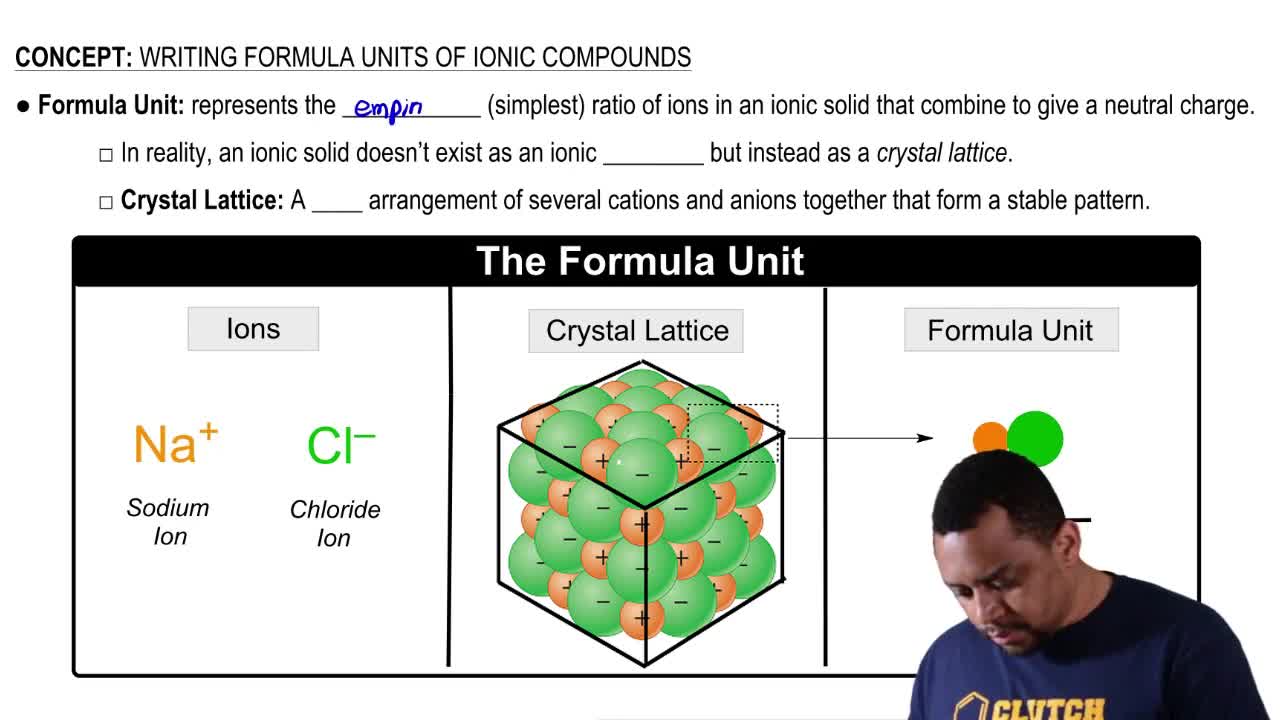
 01:46
01:46