 Indietro
Introduction to Chemistry: Atoms & Elements
 02:53
02:53
Termini in questo insieme (28)
An atom is the smallest identifiable unit of an element.
There are approximately 91 natural elements and about 20 synthetic elements created by scientists.
Democritus proposed that matter is composed of small indivisible particles called atomos or atoms.
All matter is made of atoms; atoms of an element are identical; atoms cannot be broken down; atoms combine in whole-number ratios to form compounds.
The mass ratio of elements in a compound is always the same, e.g., carbon dioxide is always CO\(2\).
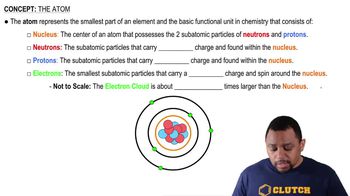
Thomson discovered the electron, a negatively charged particle smaller than atoms, and proposed the plum pudding model.
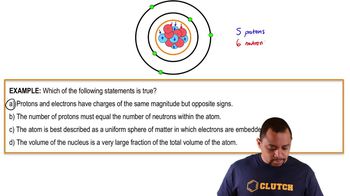
Electrons are embedded in a sphere of positive charge, making the atom neutral overall.
Electron mass: 9.11 × 10⁻²⁸ g; Proton mass: 1.67 × 10⁻²⁴ g.
Alpha particles were fired at gold foil; most passed through, but some deflected, proving atoms have a dense, positively charged nucleus.
An atom is about 1 × 10⁻⁸ cm in diameter; its nucleus is about 1 × 10-13 cm, much smaller.
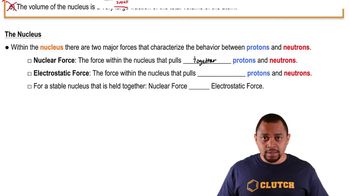
The nucleus contains protons (positive charge) and neutrons (neutral charge).
Atomic number (Z) = number of protons; Mass number (A) = protons + neutrons in the nucleus.
Number of neutrons = Mass number (A) - Atomic number (Z).
Atoms of the same element with the same number of protons but different numbers of neutrons.
Protium: 1 proton, 0 neutrons; Deuterium: 1 proton, 1 neutron; Tritium: 1 proton, 2 neutrons (radioactive).
Atomic mass is the weighted average mass of all isotopes, calculated by summing (fractional abundance × isotope mass).
Mendeleev arranged elements by increasing atomic mass and grouped elements with similar properties together, predicting undiscovered elements.
Metals, nonmetals, and metalloids (semimetals) with distinct physical and chemical properties.
Metals are shiny, conduct heat and electricity, malleable, ductile, and tend to lose electrons forming cations.
Nonmetals can be solids, liquids, or gases; poor conductors; brittle solids; tend to gain electrons forming anions.
Metalloids have properties of both metals and nonmetals; they are semiconductors, e.g., silicon is shiny, brittle, and conducts electricity poorly.
Element properties repeat periodically when elements are arranged by increasing atomic number.
Groups are vertical columns with similar properties; periods are horizontal rows indicating energy levels.
Group A (representative) elements include alkali metals, alkaline earth metals, pnictogens, chalcogens, halogens, and noble gases with varying reactivities.
Transition elements are in the middle of the table with unpredictable properties; inner transition elements include lanthanides and actinides.
Metals lose electrons to form positive ions (cations); nonmetals gain electrons to form negative ions (anions).
Group IA metals form +1 ions; Group VIA nonmetals form -2 ions.
Symbols are 1 or 2 letters; first letter capitalized, second letter lowercase if present.