 Indietro
Introduction to Chemistry Essentials
 01:59
01:59
Termini in questo insieme (24)
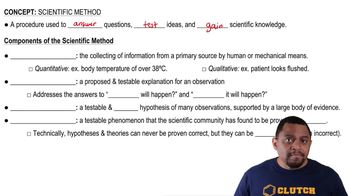
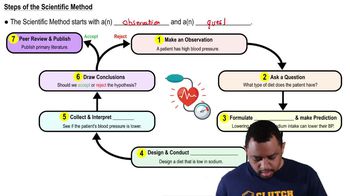
The scientific method is a process involving observation, hypothesis formation, experimentation, and theory confirmation or revision.
An atom is the smallest particle of an element that retains the chemical characteristics of that element.
A molecule consists of two or more atoms chemically bonded together, with varying strengths, lengths, and shapes.
A compound is made of two or more different elements chemically bonded in fixed proportions and can be separated chemically.
Matter is anything that has mass and occupies space.
Intensive properties do not depend on the amount of matter; extensive properties depend on the amount.
Physical properties can be measured without changing the substance; chemical properties describe how a substance reacts.
CO2 has one carbon and two oxygen atoms; CO has one carbon and one oxygen atom, with different properties like binding to hemoglobin.
The three states are solid, liquid, and gas, differing in shape, volume, compressibility, and flow.
Solids have fixed shape and volume; liquids have indefinite shape but fixed volume; gases have indefinite shape and volume.
Heat (q) is the transfer of energy due to temperature differences.
Work (w) is the exertion of a force through a distance: \(w=F \times d\).
Energy cannot be created or destroyed, only converted from one form to another; total energy in equals total energy out.
Total energy E is the sum of heat and work: \(E = q + w\).
Potential energy is stored energy; kinetic energy is energy of motion, calculated as \(KE = \frac{1}{2} m u^2\).
Molecular formulas show the number of atoms; structural formulas show how atoms are bonded.
The SI system is the International System of Units, a standardized metric system for measurements.
Kelvin temperature is Celsius plus 273: \(K = ^\circ C + 273\).
Density is mass per unit volume: \(\text{Density} = \frac{\text{Mass}}{\text{Volume}}\).
Accuracy is how close a measurement is to the true value; precision is how reproducible measurements are.
Significant figures are the digits recorded in a measurement, reflecting its precision and uncertainty.
If the first digit removed is less than 5, round down by dropping it and all following digits.
Dimensional analysis uses conversion factors to convert quantities between units by canceling units.
Multiply miles by 1.6093 km/mi, then by 1000 m/km, and divide by 3600 s/hr to get m/s.