 Indietro
Introduction to Chemistry Exam 1 Study Guide
 01:59
01:59
Termini in questo insieme (28)
Chemistry is the study of matter, its properties, how and why substances combine or separate, and how substances interact with energy.
Significant figures include all non-zero digits, zeros between significant digits, and trailing zeros in a decimal number.
Dimensional analysis is used to convert between units by multiplying by conversion factors, such as inches to feet or seconds to minutes.
Use the prefix values to multiply or divide: milli = 10-3, micro = 10-6, kilo = 103, mega = 106.
Density is calculated as \(\rho = \frac{m}{V}\), where m is mass and V is volume.
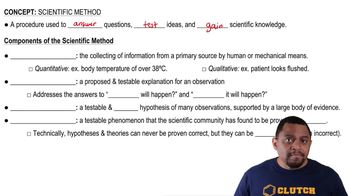
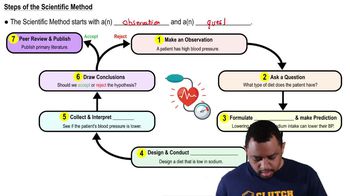
Observation, hypothesis, experimentation, scientific laws, and theories.
Uncertain digits are the last digit in a measurement that is estimated and not exact.
Units include meters (m), liters (L), grams (g), seconds (s), and moles (mol).
An element is a pure substance of one type of atom; a molecule is two or more atoms bonded; a compound is a molecule with different elements.
Solids have fixed shape and volume, liquids have fixed volume but no fixed shape, gases have neither fixed shape nor volume.
Pure substances have uniform composition; mixtures contain two or more substances; heterogeneous mixtures have visibly different parts; homogeneous mixtures are uniform throughout.
Physical changes alter appearance without changing composition; chemical changes produce new substances.
Endothermic reactions absorb heat; exothermic reactions release heat.
Use \(q = m \times c \times \Delta T\), where q is heat, m is mass, c is specific heat, and ΔT is temperature change.
Techniques include filtration, distillation, chromatography, and centrifugation.
Mass is neither created nor destroyed in a chemical reaction; total mass remains constant.
Forms include kinetic, potential, thermal, chemical, and nuclear energy.
Protons are positive, neutrons are neutral, electrons are negative; protons and neutrons are in the nucleus, electrons orbit around it.
Main groups include alkali metals, alkaline earth metals, halogens, and noble gases, each with characteristic properties.
Group 1: +1, Group 2: +2, Group 17: -1, Group 18: 0 (noble gases).
Isotopes are atoms of the same element with different numbers of neutrons.
Calculate average atomic mass by summing (isotope mass × fractional abundance) for all isotopes.
Protons = atomic number; electrons = protons ± charge; neutrons = mass number - protons.
Use moles of each element to find the simplest whole number ratio.
Empirical formula shows simplest ratio of atoms; molecular formula shows actual number of atoms.
Diatomic molecules consist of two atoms, such as H2, N2, O2, F2, Cl2, Br2, and I2.
Ionic compounds combine cations and anions; binary molecular compounds use prefixes for number of atoms; acids often start with 'hydro-' and end with '-ic acid'.
Name cation first, then anion; use prefixes for molecular compounds; acids named based on anion ending (e.g., -ate to -ic acid).