 Indietro
Introduction to Chemistry - Key Concepts
 01:52
01:52
Termini in questo insieme (24)
Chemistry is the science that seeks to understand the properties and behaviour of matter by studying atoms and molecules.
Physical properties describe a substance without changing its chemical composition (e.g., boiling point). Chemical properties describe how a substance reacts chemically (e.g., reactivity with oxygen).
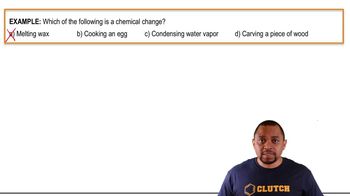
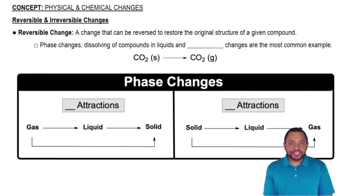
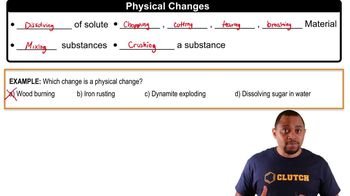
Physical changes do not alter chemical composition. Chemical changes involve conversion of reactants to products (chemical reactions).
Standard units in science include metre (m) for length, kilogram (kg) for mass, second (s) for time, kelvin (K) for temperature, mole (mol) for amount of substance, ampere (A) for electric current, and candela (cd) for luminous intensity.
SI prefixes describe very large or very small numbers by multiplying the base unit by powers of ten (e.g., kilo = 103, milli = 10-3).
Significant figures reflect the certainty in a measurement. All nonzero digits and interior zeros are significant; leading zeros are not; trailing zeros may or may not be significant depending on context.
The result carries the same number of decimal places as the quantity with the fewest decimal places.
The result carries the same number of significant figures as the factor with the fewest significant figures.
Accuracy is how close a measurement is to the actual value. Precision is how close repeated measurements are to each other.
1. Identify given information. 2. Identify what to find. 3. Devise a plan using equations and unit conversions.
Dimensional analysis is a method to convert units and ensure units cancel properly in calculations.
Atoms are tiny, indestructible particles; atoms of an element have the same mass; atoms combine in whole-number ratios; atoms rearrange in reactions but do not change into other elements.
Most mass and positive charge are in a small nucleus; most of the atom is empty space with electrons dispersed.
Protons: positive charge +1; Neutrons: neutral; Electrons: negative charge -1.
The atomic number is the number of protons in the nucleus and is constant for each element.
The number of neutrons and electrons can vary without changing the element's identity.
Ions form when atoms gain or lose electrons, becoming charged species: cations (+) lose electrons, anions (-) gain electrons.
Metals are typically conductive and malleable; nonmetals are insulators and brittle; metalloids have properties intermediate between metals and nonmetals.
An ionic bond forms between a metal and a nonmetal due to transfer of electrons, resulting in oppositely charged ions attracting.
A covalent bond forms between two nonmetals by sharing electrons.
Name the cation first, then the anion with suffix -ide (e.g., KBr is potassium bromide).
Polyatomic ions are charged groups of atoms that act as a single ion in ionic compounds (e.g., NH4+ ammonium, NO3- nitrate).
The periodic table arranges elements by increasing atomic number and groups elements with similar properties into columns (groups) and rows (periods).
Main group elements are in groups 1, 2, and 13-18; transition metals are in groups 3-12.