 Indietro
Introduction to Chemistry - Key Concepts and Math Review
 01:59
01:59
Termini in questo insieme (21)
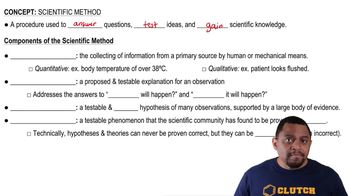
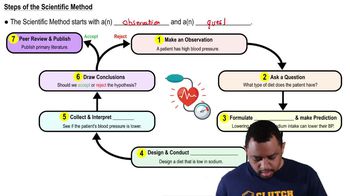
The scientific method is a process of understanding natural phenomena through observations and critical thinking, involving making observations, forming hypotheses, designing experiments, and drawing conclusions.
Make observations, form a hypothesis, design experiments, and draw a conclusion. The hypothesis is modified if experimental results do not support it.
Observation: Noting facts.
Hypothesis: A testable explanation.
Experiment: Testing the hypothesis.
Conclusion: Result interpretation.
An integer is a whole number that is not a fraction or decimal; it can be positive, negative, or zero (e.g., -2, 0, 3).
A factor divides a number evenly without remainder. A common factor divides every number in a group evenly.
The GCF is the largest factor common to two or more numbers (e.g., GCF of 20 and 30 is 10).
A multiple is the product of a number and an integer. The LCM is the smallest number divisible by two or more numbers (e.g., LCM of 8 and 12 is 24).
Prime numbers have exactly two factors: 1 and itself. Composite numbers have more than two factors.
Addition (+), subtraction (-), multiplication (×), division (÷), exponentiation (^), and logarithm (log).
Order of operations: Parentheses, Exponents, Multiplication, Division, Addition, Subtraction.
Numerator: Top number, parts of interest.
Denominator: Bottom number, total parts.
Proper fraction: Numerator less than denominator.
Improper fraction: Numerator equal or greater than denominator.
Divide numerator by denominator; quotient is whole number, remainder is new numerator.
Multiply whole number by denominator, add numerator; sum is new numerator over original denominator.
Make denominators equal (find LCM), then add or subtract numerators; denominator stays the same.
Multiply numerators together and denominators together; simplify if possible.
Flip the divisor (right fraction) and multiply by the dividend (left fraction).
Addition: a + b = b + a
Multiplication: a × b = b × a
a(b + c) = ab + ac; similarly for subtraction: a(b - c) = ab - ac.
A way to express very large or small numbers as a coefficient between 1 and 9 multiplied by 10 raised to a power (e.g., 1.2 × 10⁵).
Positive exponents move the decimal to the right (large numbers), negative exponents move it to the left (small numbers).