Skip to main content
Introduction to Chemistry
Il mio corso
Impara
Preparazione agli esami
AI Tutor
Guide di studio
Flashcard
Esplora
Prova l'app
Il mio corso
Impara
Preparazione agli esami
AI Tutor
Guide di studio
Flashcard
Esplora
Prova l'app
Indietro
Introduction to Chemistry - Measurement & Problem Solving
Puoi toccare per girare la carta.
What is the difference between measured and exact numbers?
Puoi toccare per girare la carta.
👆
What is the difference between measured and exact numbers?
Measured numbers
are inexact and have uncertainty (e.g., 5.25 m).
Exact numbers
are counted values with no uncertainty (e.g., 24 students).
Avanzamenti del tracciato
I pulsanti di controllo sono stati cambiati in modalità "navigazione".
1/23
Video consigliati
VideoThumbView.guidedCourse
01:59
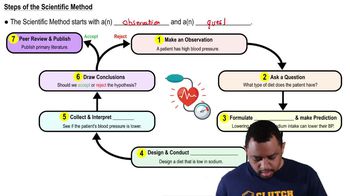
The Scientific Method Concept 1
18747
views
653
rank
8
comments
VideoThumbView.guidedCourse
01:38
The Scientific Method Concept 2
10622
views
277
rank
2
comments
VideoThumbView.guidedCourse
00:46
The Scientific Method Example 1
11581
views
418
rank
2
comments
Termini in questo insieme (23)
Nascondere definizioni
What is the difference between measured and exact numbers?
Measured numbers
are inexact and have uncertainty (e.g., 5.25 m).
Exact numbers
are counted values with no uncertainty (e.g., 24 students).
Why should units always be included in measurements?
Units specify the quantity measured and are essential for clarity and correctness, e.g., write 3.1 miles, not just 3.1.
What does uncertainty in measurement mean?
Uncertainty means the last digit in a measurement is estimated; no measurement is perfectly exact.
What are the two main measurement systems used in science?
The
English system
and the
metric system
, with metric being more common due to powers of 10.
Define accuracy and precision in measurements.
Accuracy
is closeness to the true value;
precision
is consistency among repeated measurements.
How does the number of hash marks on a ruler affect measurement precision?
More hash marks mean less uncertainty and higher precision in length measurements.
What is the difference between mass and weight?
Mass is the amount of matter (grams), weight is the force of gravity on an object; on Earth they are often used interchangeably.
How is volume measured in the lab?
Volume is measured using equipment like graduated cylinders, pipets, and burets, typically in liters or milliliters.
What is the significance of the meniscus in volume measurement?
Volume should be read at the bottom of the meniscus, not the top, for accuracy.
Explain scientific notation and its use.
Scientific notation expresses very large or small numbers as a decimal between 1 and 9 multiplied by 10 raised to an exponent.
How do you convert 5983 to scientific notation?
Move decimal to get 5.983 and multiply by \(10^3\), so 5.983 x 10^3.
What are significant figures?
Digits in a measurement that are known with certainty plus one estimated digit, reflecting precision.
List the rules for counting significant figures.
Non-zero digits are significant; zeros between non-zero digits are significant; leading zeros are not; trailing zeros depend on decimal presence.
How do you round numbers based on significant figures?
If the digit to drop is 5 or greater, round up; if 4 or less, leave the last significant digit unchanged.
How do you handle significant figures in addition and subtraction?
Answer should have the same number of decimal places as the measurement with the fewest decimal places.
How do you handle significant figures in multiplication and division?
Answer should have the same number of significant figures as the measurement with the fewest sig figs.
What is a unit conversion factor?
A ratio of two equivalent quantities used to convert units, e.g., 1 foot = 12 inches.
What are exact equivalents in unit conversions?
Units exactly equal to each other with infinite significant figures, e.g., 1 liter = 1000 milliliters.
What is unit analysis in problem solving?
A method that tracks units through calculations to ensure correct final units and prevent errors.
How is density defined and calculated?
Density is mass per unit volume, calculated as \(\frac{mass}{volume}\), units like g/mL or g/cm3.
What does it mean if an object floats or sinks in water based on density?
If density is less than 1.00 g/mL, it floats; if greater, it sinks.
How do you calculate volume by displacement?
Volume of an irregular solid equals the difference between final and initial liquid volumes when submerged.
What is the percent concept in chemistry?
Percent expresses a part-to-whole ratio as parts per 100, calculated as (part/total) x 100.
 IndietroIndietro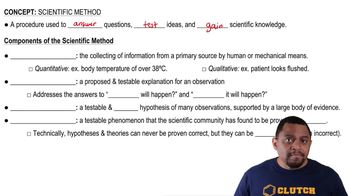
 01:59
01:59