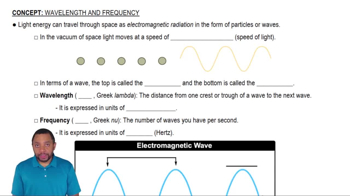
Electromagnetic radiation is composed of perpendicular oscillating waves: one electric field wave and one magnetic field wave.
What is the speed of light in a vacuum?
The speed of light in a vacuum is a constant 3.00 × 10\(8\) m/s.
Define wavelength, amplitude, and frequency of a wave.
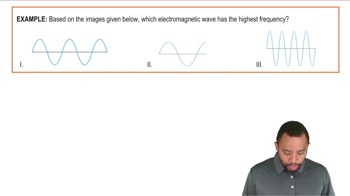
Wavelength is the distance between crests, amplitude is the height from node to crest, and frequency is the number of waves passing a point per second.
What is the unit of frequency and its meaning?
Frequency is measured in Hertz (Hz), which equals one cycle per second (s\(^{-1}\)).
How are wavelength and frequency related for electromagnetic waves?
Wavelength and frequency are inversely related; their product equals the speed of light: \(\lambda \nu = c\).
How can you calculate frequency if wavelength is known?
Frequency can be calculated by \(\nu = \frac{c}{\lambda}\), where c is the speed of light and λ is wavelength.
What determines the color of visible light?
The color of light is determined by its wavelength; different wavelengths correspond to different colors.
What did Fraunhofer lines reveal about sunlight?
Fraunhofer lines are dark gaps in the solar spectrum caused by gaseous atoms in the sun absorbing specific wavelengths.
What is an atomic emission spectrum?
An atomic emission spectrum is the set of bright lines emitted by atoms at high temperatures, unique to each element.
What is the relationship between atomic absorption and emission spectra?
Dark lines in an element's absorption spectrum occur at the same wavelengths as bright lines in its emission spectrum.
State Planck's quantum theory formula for energy.
Energy of a quantum is given by \(E = h\nu\), where h is Planck's constant and ν is frequency.
What is Planck's constant value?
Planck's constant, h, is 6.626 × 10\(^{-34}\) J·s.
Explain the photoelectric effect observed by Hertz and Lenard.
Metals emit electrons when light shines on them only if the light frequency exceeds a threshold; electron energy depends on frequency, not intensity.
How did Einstein explain the photoelectric effect?
Einstein proposed light behaves as photons with energy proportional to frequency, explaining electron emission from metals.
What is the Bohr model of the hydrogen atom?
Bohr's model describes electrons orbiting the nucleus in fixed, quantized energy levels with energy proportional to orbit distance.
What happens when an electron moves between energy levels in the Bohr model?
Electron transitions between orbits involve energy changes; moving outward absorbs energy, moving inward releases energy.
Define ground state and excited state in atomic energy levels.
Ground state is the lowest energy level (n=1); excited states are higher energy levels (n>1) an electron can occupy after absorbing energy.
What is the Heisenberg Uncertainty Principle?
It is impossible to know both the exact position and velocity of an electron simultaneously.
What are quantum numbers and their significance?
Quantum numbers (n, l, m_l, m_s) uniquely identify electron orbitals and describe size, shape, orientation, and spin.
Describe the shapes of s, p, and d orbitals.
s orbitals are spherical, p orbitals are dumbbell-shaped, and d orbitals have more complex cloverleaf shapes.
 Indietro
 01:12
01:12