Dmitri Mendeleev published the first periodic table in 1872.
How did Mendeleev order elements in his periodic table?
He ordered elements by atomic mass and observed a repeating pattern of properties, known as the periodic law.
What is the periodic law?
The periodic law states that elements show a repeating pattern of properties when arranged by increasing atomic mass.
What principle guides the filling order of electron orbitals?
The Aufbau Principle states that lower-energy orbitals fill before higher-energy orbitals.
What is Hund's Rule?
If two or more degenerate orbitals are available, one electron goes into each until all are half-full, with electrons having the same spin.
What is the Pauli Exclusion Principle?
An orbital can hold a maximum of two electrons, which must have opposite spins.
What are valence electrons?
Valence electrons are the electrons in the outermost shell of an atom.
How do elements in the same group relate in terms of valence electrons?
Elements in the same group have the same number of valence electrons in similar orbitals, leading to similar chemical properties.
What is effective nuclear charge (\(Z_{eff}\))?
It is the nuclear charge actually felt by an electron, calculated as Zactual − electron shielding.
How does atomic radius change across a period?
Atomic radius decreases across a period due to increasing effective nuclear charge pulling electrons closer.
How does atomic radius change down a group?
Atomic radius increases down a group because electrons occupy higher energy levels farther from the nucleus.
How do cations compare in size to their parent atoms?
Cations are smaller than their parent atoms because they lose electrons, reducing electron-electron repulsion.
How do anions compare in size to their parent atoms?
Anions are larger than their parent atoms due to additional electrons increasing electron-electron repulsion.
What is ionization energy?
Ionization energy is the energy required to remove the highest-energy electron from a neutral atom in the gas phase.
How does ionization energy generally change across a period?
Ionization energy generally increases across a period as atoms hold electrons more tightly.
What is electron affinity?
Electron affinity is the energy released when a neutral atom gains an electron to form an anion.
Which group of elements typically has the highest electron affinity?
The halogens (Group 17) typically have the highest electron affinity.
What is the electron configuration shorthand for sodium (Na)?
Na is [Ne] 3s1.
What is the difference between actual and predicted electron configurations in transition metals like Cr and Cu?
Transition metals often have electron configurations that differ from predictions to achieve more stable half-filled or filled d subshells, e.g., Cr is [Ar] 4s1 3d5 instead of [Ar] 4s2 3d4.
From which orbitals do transition metals lose electrons when forming cations?
Transition metals lose electrons from the highest principal quantum number orbitals first, typically the 4s electrons.
 Indietro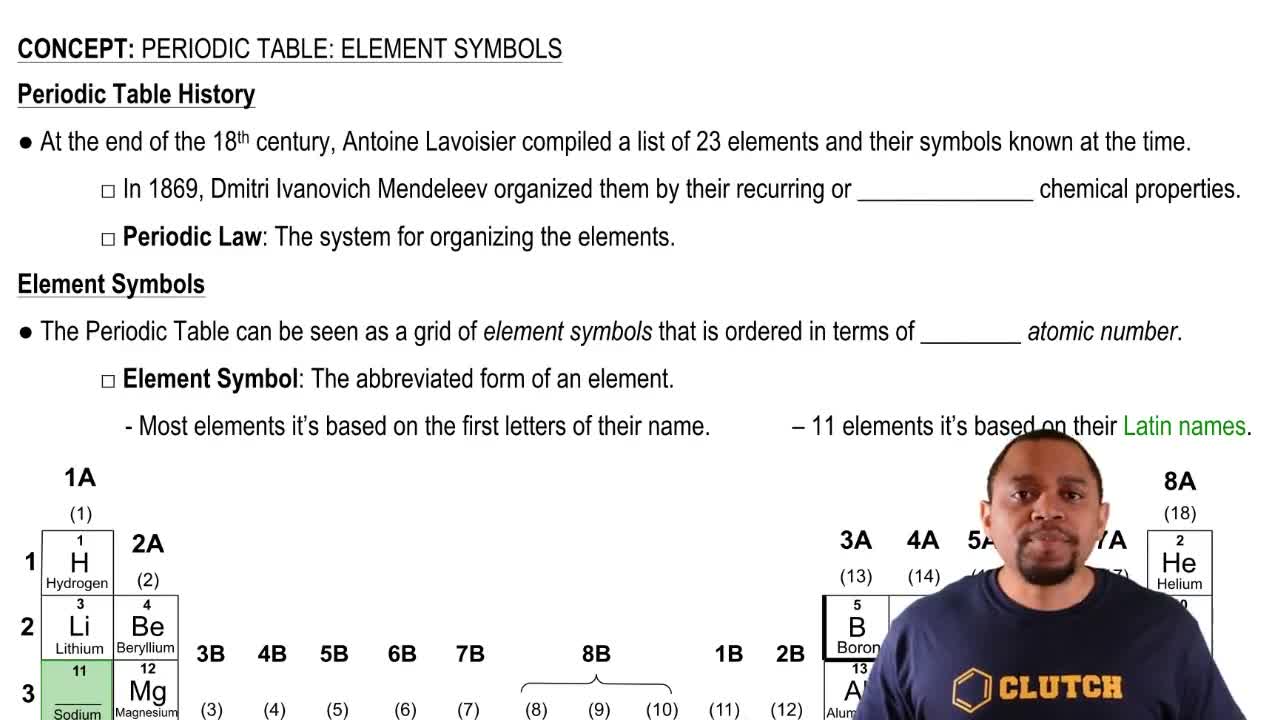
 04:01
04:01