 Indietro
Properties of Solutions - Introduction to Chemistry
 06:36
06:36

Termini in questo insieme (20)
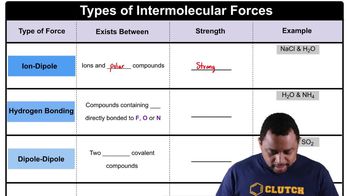
Dispersion forces, Dipole-Dipole, Hydrogen bonding, and Ion-Dipole.
Polar solutes dissolve in polar solvents, and nonpolar solutes dissolve in nonpolar solvents due to similar intermolecular forces.
The maximum amount of solute that can dissolve in a given amount of solvent at a specific temperature.
Positive entropy change (ΔSsoln > 0), indicating increased randomness when dissolving.
Breaking solute-solute attractions (ΔHsolute), breaking solvent-solvent attractions (ΔHsolvent), and forming solute-solvent attractions (ΔHmix).
ΔHsoln = ΔHsolute + ΔHsolvent + ΔHmix
Solvation is the process of solvent molecules surrounding solute particles; hydration is solvation when water is the solvent.
Higher lattice energy means stronger ionic bonds, leading to lower solubility in water.
Solubility of solids usually increases with temperature; solubility of gases decreases as temperature increases.
Sgas = kH × Pgas, where Sgas is solubility, kH is Henry's constant, and Pgas is partial pressure of the gas.
Molarity (M) = moles of solute / liters of solution; Molality (m) = moles of solute / kilograms of solvent.
Molarity changes with temperature because volume changes; molality does not.
Pressure exerted by a gas in equilibrium with its liquid at a given temperature.
Higher temperature increases vapor pressure; stronger intermolecular forces decrease vapor pressure.
Psolution = Psolvent × Xsolvent, where Xsolvent is mole fraction of solvent.
Properties that depend on the number of solute particles, not their identity: vapor pressure lowering, boiling point elevation, freezing point depression, osmotic pressure.
The ratio of moles of particles in solution to moles of solute dissolved; i = 1 for nonelectrolytes, >1 for electrolytes.
ΔTb = Kb × m × i and ΔTf = Kf × m × i, where m is molality and i is van't Hoff factor.
The movement of solvent through a semipermeable membrane from low to high solute concentration.
Π = i × M × R × T, where M is molarity, R is gas constant, T is temperature in Kelvin.