Skip to main content
Macroeconomics
Il mio corso
Impara
Preparazione agli esami
AI Tutor
Guide di studio
Flashcard
Esplora
Prova l'app
Il mio corso
Impara
Preparazione agli esami
AI Tutor
Guide di studio
Flashcard
Esplora
Prova l'app
Indietro
Arguments Against International Trade definitions
Puoi toccare per girare la carta.
Protectionism
Puoi toccare per girare la carta.
👆
Protectionism
Policy aimed at shielding domestic industries from foreign competition, often through tariffs or quotas.
Avanzamenti del tracciato
I pulsanti di controllo sono stati cambiati in modalità "navigazione".
1/15
Flashcard correlate
Pratica correlata
Video consigliati
Arguments Against International Trade quiz
Arguments Against International Trade
15 Termini
Arguments Against International Trade
9. International Trade
10 Problemi
Argomento
Import Quotas and VERs
9. International Trade
10 Problemi
Argomento
9. International Trade
5 Argomenti
14 Problemi
Capitolo
VideoThumbView.guidedCourse
07:50
Arguments Against International Trade
2308
views
35
rank
Termini in questo insieme (15)
Nascondere definizioni
Protectionism
Policy aimed at shielding domestic industries from foreign competition, often through tariffs or quotas.
Comparative Advantage
Ability of a country to produce a good at a lower opportunity cost than another, guiding trade patterns.
Jobs Argument
Claim that international trade causes domestic job losses, though jobs often shift to more competitive industries.
National Security Argument
Concern that trading certain goods may empower potential adversaries, though defining risks is often ambiguous.
Infant Industry Argument
Justification for protecting new industries until they become competitive, requiring government to predict winners.
Government Speculation
Process where authorities attempt to pick future successful industries, often criticized as outside their expertise.
Unfair Competition
Situation where foreign producers benefit from subsidies or different regulations, potentially disadvantaging local firms.
Consumer Benefit
Advantage gained by buyers when imports lower prices, often outweighing producer losses in trade scenarios.
Total Surplus
Combined gains of consumers and producers in a market, typically increased by open international trade.
Protection as a Bargaining Chip
Use of trade barriers as leverage in negotiations, which can backfire and reduce political influence.
Political Clout
Influence or standing a country holds in international relations, which can be diminished by failed trade threats.
Variety of Goods
Expanded selection of products available to consumers due to access to international markets.
Economies of Scale
Cost advantages achieved by increasing production, often realized through access to larger global markets.
Increased Competition
Market condition where more firms vie for consumers, driving efficiency and innovation.
Flow of Ideas
Spread of technology and knowledge across borders, facilitated by international trade.
 IndietroIndietro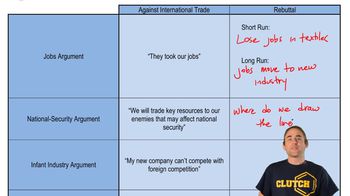
 07:50
07:50