Skip to main content
Macroeconomics
Il mio corso
Impara
Preparazione agli esami
AI Tutor
Guide di studio
Flashcard
Esplora
Prova l'app
Il mio corso
Impara
Preparazione agli esami
AI Tutor
Guide di studio
Flashcard
Esplora
Prova l'app
Indietro
Average Propensity to Consume and Save definitions
Puoi toccare per girare la carta.
Disposable Income
Puoi toccare per girare la carta.
👆
Disposable Income
Amount remaining after taxes, available for allocation between spending on goods and services or setting aside for future use.
Avanzamenti del tracciato
I pulsanti di controllo sono stati cambiati in modalità "navigazione".
1/13
Flashcard correlate
Pratica correlata
Video consigliati
Average Propensity to Consume and Save quiz
Average Propensity to Consume and Save
15 Termini
Average Propensity to Consume and Save
14. Income and Consumption
10 Problemi
Argomento
Multiplier Effect of Investment Spending
14. Income and Consumption
10 Problemi
Argomento
15. Income and Consumption
5 Argomenti
15 Problemi
Capitolo
VideoThumbView.guidedCourse
01:50
Average Propensity to Consume and Save
1361
views
5
rank
Termini in questo insieme (13)
Nascondere definizioni
Disposable Income
Amount remaining after taxes, available for allocation between spending on goods and services or setting aside for future use.
Consumption
Total spending by households on goods and services, representing one possible use of after-tax earnings.
Savings
Portion of after-tax earnings not spent on goods and services, set aside for future needs or investment.
Average Propensity to Consume
Ratio of total household spending to total after-tax earnings, indicating the share of income used for purchases.
Average Propensity to Save
Ratio of total household savings to total after-tax earnings, showing the share of income not spent.
Marginal Propensity to Consume
Fraction of each additional dollar of after-tax earnings that is spent on goods and services.
Marginal Propensity to Save
Fraction of each additional dollar of after-tax earnings that is set aside rather than spent.
Total Amount
Sum of all units, such as spending or savings, accumulated over a period, used in calculating average rates.
Rate of Consumption
Proportion of after-tax earnings allocated to spending, often expressed as a percentage.
Rate of Savings
Proportion of after-tax earnings allocated to setting aside funds, often expressed as a percentage.
Change in Consumption
Increase in household spending resulting from an increase in after-tax earnings.
Change in Savings
Increase in household funds set aside resulting from an increase in after-tax earnings.
Formula
Mathematical expression used to calculate economic measures such as ratios of spending or savings to income.
 IndietroIndietro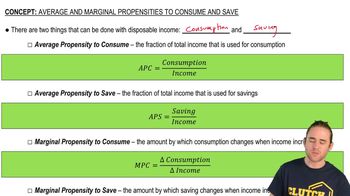
 01:50
01:50