Skip to main content
Macroeconomics
Il mio corso
Impara
Preparazione agli esami
AI Tutor
Guide di studio
Flashcard
Esplora
Prova l'app
Il mio corso
Impara
Preparazione agli esami
AI Tutor
Guide di studio
Flashcard
Esplora
Prova l'app
Indietro
Calculating Bond and Stock Prices quiz
Puoi toccare per girare la carta.
What is the present value formula used to discount future cash flows?
Puoi toccare per girare la carta.
👆
What is the present value formula used to discount future cash flows?
The present value formula is PV = FV / (1 + r)^n, where FV is future value, r is the interest rate, and n is the number of periods.
Avanzamenti del tracciato
I pulsanti di controllo sono stati cambiati in modalità "navigazione".
1/15
Flashcard correlate
Pratica correlata
Video consigliati
Calculating Bond and Stock Prices definitions
Calculating Bond and Stock Prices
15 Termini
Calculating Bond and Stock Prices
13. The Financial System
5 Problemi
Argomento
Time Value of Money Calculations
13. The Financial System
9 Problemi
Argomento
14. The Financial System - Part 1 of 2
8 Argomenti
15 Problemi
Capitolo
13. The Financial System - Part 2 of 2
1 Argomento
3 Problemi
Capitolo
VideoThumbView.guidedCourse
05:16
Calculating Stock and Bond Price
1386
views
11
rank
Termini in questo insieme (15)
Nascondere definizioni
What is the present value formula used to discount future cash flows?
The present value formula is PV = FV / (1 + r)^n, where FV is future value, r is the interest rate, and n is the number of periods.
What are the two main types of cash flows received from a bond?
The two main types are periodic interest (coupon) payments and the principal repayment at maturity.
How is the price of a bond today determined?
The bond price is the sum of the present values of all future interest payments and the present value of the principal repayment.
What does the term 'coupon' refer to in bond valuation?
The coupon refers to the periodic interest payment made by the bond to the bondholder.
How do you calculate the present value of a bond’s coupon payment received in the second year?
You discount the coupon payment by dividing it by (1 + r)^2, where r is the interest rate.
Why do we discount each bond cash flow by a different number of periods?
Because each cash flow is received at a different time, so each must be discounted back to the present by the number of years until it is received.
What is the main difference between the cash flows from bonds and stocks?
Bonds pay fixed interest and return principal, while stocks pay dividends that can grow over time and do not return principal.
How are dividends from stocks typically expected to change over time?
Dividends are generally expected to grow as the company grows.
What formula is used to calculate the price of a stock with growing dividends?
The formula is PV = Dividend / (Interest rate - Growth rate).
Why is the growth rate subtracted from the interest rate in the stock valuation formula?
Subtracting the growth rate accounts for the expected increase in dividends over time.
What does the 'interest rate' represent in the context of stock and bond valuation?
It represents the required rate of return or discount rate used to bring future cash flows to present value.
If a bond pays \$100 in interest each year for 3 years and \$1,000 principal at maturity, how would you find its price?
You would discount each \$100 interest payment and the \$1,000 principal to present value and sum them.
Why do we use the time value of money when valuing bonds and stocks?
Because money received in the future is worth less than money received today, so we discount future cash flows to present value.
What information do you need to calculate the price of a stock using the dividend growth model?
You need the expected dividend, the required interest rate (discount rate), and the expected growth rate of dividends.
How does the valuation of a bond differ from the valuation of a stock?
Bond valuation sums discounted fixed payments and principal, while stock valuation discounts expected growing dividends using a specific formula.
 IndietroIndietro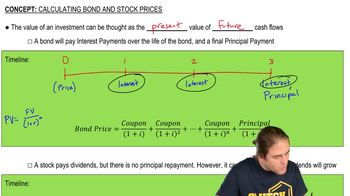
 05:16
05:16