Skip to main content
Macroeconomics
Il mio corso
Impara
Preparazione agli esami
AI Tutor
Guide di studio
Flashcard
Esplora
Prova l'app
Il mio corso
Impara
Preparazione agli esami
AI Tutor
Guide di studio
Flashcard
Esplora
Prova l'app
Indietro
Communism and Karl Marx definitions
Puoi toccare per girare la carta.
Communist Model
Puoi toccare per girare la carta.
👆
Communist Model
A radical critique of free markets, envisioning worker ownership of production and elimination of capitalist profit.
Avanzamenti del tracciato
I pulsanti di controllo sono stati cambiati in modalità "navigazione".
1/15
Flashcard correlate
Pratica correlata
Video consigliati
Communism and Karl Marx quiz #1
Communism and Karl Marx
10 Termini
Communism and Karl Marx
22. Macroeconomic Schools of Thought
10 Problemi
Argomento
Austrian Model
22. Macroeconomic Schools of Thought
10 Problemi
Argomento
24. Macroeconomic Schools of Thought
7 Argomenti
15 Problemi
Capitolo
VideoThumbView.guidedCourse
05:32
Communism and Karl Marx
637
views
2
rank
Termini in questo insieme (15)
Nascondere definizioni
Communist Model
A radical critique of free markets, envisioning worker ownership of production and elimination of capitalist profit.
Karl Marx
A 19th-century economist and philosopher who theorized that capitalism would inevitably lead to worker-led revolution.
Labor Theory of Value
A concept asserting that the worth of goods and services is determined solely by the labor invested in their creation.
Free Market System
An economic structure where prices and production are dictated by private owners and voluntary exchange, not central planning.
Means of Production
Physical assets like factories and machinery required to produce goods, typically controlled by capitalists in capitalism.
Capitalist
An individual or group owning productive resources, profiting from the labor of others without direct contribution to value.
Exploitation
A process where workers receive less compensation than the value they generate, with the surplus accruing to owners.
Monopoly
A situation where a small number of firms or individuals control the majority of production and market power.
Wages
Compensation paid to workers, often described in Marxist theory as being suppressed to minimal survival levels.
Profits
The financial gains capitalists receive, viewed by Marx as derived from underpaying labor relative to value created.
Rebellion
A predicted uprising by the working class to take control of productive assets from capitalists.
Soviet Union
A state formed after the Bolshevik revolution, representing a major historical attempt to implement Marxist principles.
Bolshevik Party
A revolutionary group that led the 1917 Russian uprising, establishing the first large-scale communist government.
Dictatorship
A form of governance marked by centralized, often oppressive control, as seen in some communist states.
Survival Level
The minimum standard of living, theorized by Marx as the baseline to which worker compensation would be reduced.
 IndietroIndietro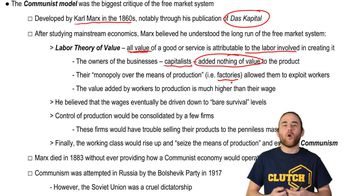
 05:32
05:32