Skip to main content
Macroeconomics
Il mio corso
Impara
Preparazione agli esami
AI Tutor
Guide di studio
Flashcard
Esplora
Prova l'app
Il mio corso
Impara
Preparazione agli esami
AI Tutor
Guide di studio
Flashcard
Esplora
Prova l'app
Indietro
Demand-Pull and Cost-Push Inflation definitions
Puoi toccare per girare la carta.
Demand-Pull Inflation
Puoi toccare per girare la carta.
👆
Demand-Pull Inflation
A rise in prices caused by increased spending when supply cannot expand, resulting in higher prices without increased output.
Avanzamenti del tracciato
I pulsanti di controllo sono stati cambiati in modalità "navigazione".
1/15
Flashcard correlate
Pratica correlata
Video consigliati
Demand-Pull and Cost-Push Inflation quiz #1
Demand-Pull and Cost-Push Inflation
16 Termini
Demand-Pull and Cost-Push Inflation
11. Unemployment and Inflation
10 Problemi
Argomento
Costs of Inflation: Shoe-leather Costs and Menu Costs
11. Unemployment and Inflation
10 Problemi
Argomento
12. Unemployment and Inflation
8 Argomenti
11 Problemi
Capitolo
VideoThumbView.guidedCourse
03:53
Demand-Pull Inflation
1747
views
22
rank
VideoThumbView.guidedCourse
02:22
Cost-Push Inflation
1302
views
25
rank
Termini in questo insieme (15)
Nascondere definizioni
Demand-Pull Inflation
A rise in prices caused by increased spending when supply cannot expand, resulting in higher prices without increased output.
Cost-Push Inflation
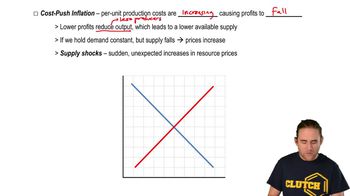
A rise in prices triggered by higher production expenses, leading to reduced profits, lower output, and fewer producers.
Equilibrium Price
The market price where quantity demanded equals quantity supplied, shifting upward during inflationary pressures.
Supply Shock
An unexpected event causing a sudden decrease in supply, often due to increased input costs, resulting in higher prices.
Quantity Supplied
The amount of goods producers are willing to sell at a given price, which may remain fixed during demand-pull inflation.
Quantity Demanded
The amount of goods consumers are willing to buy at a given price, which increases during demand-pull inflation.
Production Costs
Expenses incurred by firms to create goods, which, when rising, can reduce profits and trigger cost-push inflation.
Profit
The financial gain for firms after covering costs, which declines when production costs rise, possibly causing firms to exit the market.
Output
The total quantity of goods produced, which may decrease when firms face higher costs and lower profits.
Market Graph
A visual representation of supply and demand curves, used to illustrate shifts leading to inflation.
Price Level
The average of current prices across the entire economy, which rises during both demand-pull and cost-push inflation.
Supply Curve
A graphical line showing the relationship between price and quantity supplied, shifting left during cost-push inflation.
Demand Curve
A graphical line showing the relationship between price and quantity demanded, shifting right during demand-pull inflation.
Inflation
A general increase in prices across the economy, resulting from either heightened demand or increased production costs.
Raw Materials
Basic inputs used in production, whose price increases can trigger supply shocks and cost-push inflation.
 IndietroIndietro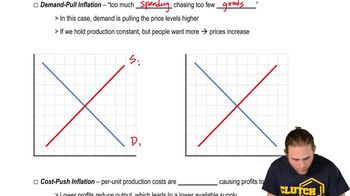
 03:53
03:53