Skip to main content
Macroeconomics
Il mio corso
Impara
Preparazione agli esami
AI Tutor
Guide di studio
Flashcard
Esplora
Prova l'app
Il mio corso
Impara
Preparazione agli esami
AI Tutor
Guide di studio
Flashcard
Esplora
Prova l'app
Indietro
Deriving the Multiplier Algebraically definitions
Puoi toccare per girare la carta.
Multiplier
Puoi toccare per girare la carta.
👆
Multiplier
A factor showing how an initial increase in spending leads to a greater overall rise in GDP through repeated rounds of consumption.
Avanzamenti del tracciato
I pulsanti di controllo sono stati cambiati in modalità "navigazione".
1/13
Flashcard correlate
Pratica correlata
Video consigliati
Deriving the Multiplier Algebraically quiz
Deriving the Multiplier Algebraically
15 Termini
Deriving the Multiplier Algebraically
15. Deriving the Aggregate Expenditures Model
10 Problemi
Argomento
AE Model: Algebraic Approach
15. Deriving the Aggregate Expenditures Model
10 Problemi
Argomento
16. Deriving the Aggregate Expenditures Model
7 Argomenti
13 Problemi
Capitolo
VideoThumbView.guidedCourse
07:15
Deriving the Multiplier Algebraically
1332
views
6
rank
Termini in questo insieme (13)
Nascondere definizioni
Multiplier
A factor showing how an initial increase in spending leads to a greater overall rise in GDP through repeated rounds of consumption.
Aggregate Expenditures
The total amount spent on consumption and investment in a private closed economy, determining equilibrium GDP.
Private Closed Economy
An economic model excluding government and international trade, focusing only on households and firms.
Consumption Function
An equation expressing consumption as the sum of autonomous consumption and a portion of income determined by the marginal propensity to consume.
Autonomous Consumption
Spending on goods and services that occurs even when income is zero, covering basic needs.
Marginal Propensity to Consume
The fraction of additional income that is spent on consumption rather than saved.
Disposable Income
Total income available for spending and saving, equal to earned income in the absence of taxes and transfers.
Equilibrium GDP
The level of output where total spending equals total production, ensuring no unplanned inventory changes.
Investment
Expenditures on capital goods that add to future productive capacity, included in aggregate expenditures.
Multiplier Effect
The process by which an initial change in spending results in a larger change in equilibrium GDP.
Autonomous Spending
Expenditures that do not depend on current income, such as basic consumption and investment.
Equilibrium
A state where aggregate expenditures and GDP are equal, resulting in stable output and income.
GDP
The total market value of all final goods and services produced within an economy during a specific period.
 IndietroIndietro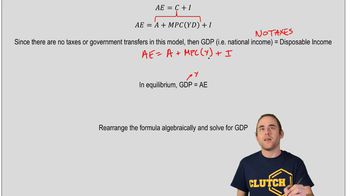
 07:15
07:15