Skip to main content
Macroeconomics
Il mio corso
Impara
Preparazione agli esami
AI Tutor
Guide di studio
Flashcard
Esplora
Prova l'app
Il mio corso
Impara
Preparazione agli esami
AI Tutor
Guide di studio
Flashcard
Esplora
Prova l'app
Indietro
Dynamic AD-AS Model: Inflation and Recession definitions
Puoi toccare per girare la carta.
Inflation
Puoi toccare per girare la carta.
👆
Inflation
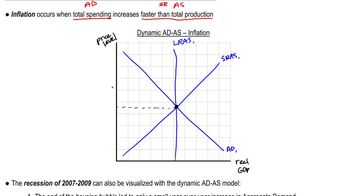
A period marked by rising prices due to total spending outpacing total production, causing the price level to increase.
Avanzamenti del tracciato
I pulsanti di controllo sono stati cambiati in modalità "navigazione".
1/15
Flashcard correlate
Pratica correlata
Video consigliati
Dynamic AD-AS Model: Inflation and Recession quiz
Dynamic AD-AS Model: Inflation and Recession
15 Termini
Dynamic AD-AS Model: Inflation and Recession
23. Dynamic AD/AS Model
10 Problemi
Argomento
Dynamic AD-AS Model: Fiscal Policy
23. Dynamic AD/AS Model
10 Problemi
Argomento
25. Dynamic AD/AS Model
4 Argomenti
15 Problemi
Capitolo
VideoThumbView.guidedCourse
06:30
Dynamic AD-AS Model: Recession
1092
views
13
rank
VideoThumbView.guidedCourse
04:05
Dynamic AD-AS Model: Inflation
1247
views
11
rank
Termini in questo insieme (15)
Nascondere definizioni
Inflation
A period marked by rising prices due to total spending outpacing total production, causing the price level to increase.
Recession
An economic downturn characterized by lower GDP and higher prices, often triggered by shocks like financial crises or supply disruptions.
Aggregate Demand
The total spending on goods and services in an economy, represented as a curve shifting right when spending increases.
Aggregate Supply
The total production of goods and services in an economy, with its shifts reflecting changes in productive capacity.
Short-Run Aggregate Supply
A curve showing total production in the short term, sensitive to temporary shocks like oil price changes.
Long-Run Aggregate Supply
A curve representing potential GDP, shifting right as technology or labor force grows, unaffected by temporary shocks.
Price Level
A measure on the vertical axis of the AD-AS graph indicating the average of current prices across the economy.
Real GDP
A measure on the horizontal axis of the AD-AS graph showing the economy's output adjusted for price changes.
Equilibrium
The point where aggregate demand and aggregate supply curves intersect, determining the economy's price level and output.
Supply Shock
A sudden event, such as a spike in oil prices, causing a significant shift in short-run aggregate supply.
Housing Bubble
A period of rapidly rising home prices followed by a sharp decline, impacting aggregate demand and triggering downturns.
Financial Crisis
A situation where credit becomes scarce, reducing investment and causing only minor increases in aggregate demand.
Potential GDP
The maximum sustainable output of an economy, increasing with improvements in technology or labor force.
Dynamic AD-AS Model
A framework where aggregate demand and supply curves shift over time, illustrating inflation and recession scenarios.
Credit Availability
The ease with which loans can be obtained, influencing investment and shifts in aggregate demand.
 IndietroIndietro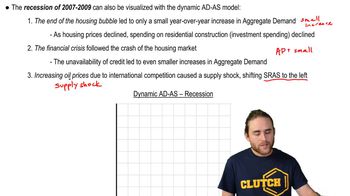
 06:30
06:30