Skip to main content
Macroeconomics
Il mio corso
Impara
Preparazione agli esami
AI Tutor
Guide di studio
Flashcard
Esplora
Prova l'app
Il mio corso
Impara
Preparazione agli esami
AI Tutor
Guide di studio
Flashcard
Esplora
Prova l'app
Indietro
Dynamic AD-AS Model: Introduction quiz
Puoi toccare per girare la carta.
What are the two main unrealistic assumptions of the standard AD-AS model?
Puoi toccare per girare la carta.
👆
What are the two main unrealistic assumptions of the standard AD-AS model?
The standard AD-AS model assumes there is no long-run inflation and no long-run economic growth.
Avanzamenti del tracciato
I pulsanti di controllo sono stati cambiati in modalità "navigazione".
1/15
Flashcard correlate
Pratica correlata
Video consigliati
Dynamic AD-AS Model: Introduction definitions
Dynamic AD-AS Model: Introduction
15 Termini
Dynamic AD-AS Model: Introduction
23. Dynamic AD/AS Model
10 Problemi
Argomento
Dynamic AD-AS Model: Inflation and Recession
23. Dynamic AD/AS Model
10 Problemi
Argomento
25. Dynamic AD/AS Model
4 Argomenti
15 Problemi
Capitolo
VideoThumbView.guidedCourse
04:59
Dynamic AD-AS Model: Introduction
242
views
7
rank
Termini in questo insieme (15)
Nascondere definizioni
What are the two main unrealistic assumptions of the standard AD-AS model?
The standard AD-AS model assumes there is no long-run inflation and no long-run economic growth.
Why does the standard AD-AS model struggle with long-term economic predictions?
Because it assumes economies return to the same equilibrium and ignores ongoing growth and inflation.
How does the standard AD-AS model incorrectly predict recessions?
It predicts that recessions are often accompanied by falling prices, which rarely happens in reality.
What is the main improvement of the dynamic AD-AS model over the standard model?
The dynamic model allows all curves to shift over time, reflecting real-world changes in the economy.
Why is the dynamic AD-AS model called 'dynamic'?
Because it allows the aggregate demand, short-run aggregate supply, and long-run aggregate supply curves to change over time.
What does the long-run aggregate supply (LRAS) curve represent?
It represents the potential GDP of the economy if it is operating at full employment.
Why does the LRAS curve shift to the right over time in the dynamic model?
Because population growth and technological improvements increase the economy's productive capacity.
What causes the short-run aggregate supply (SRAS) curve to shift to the right in the dynamic model?
The same factors as LRAS: population growth and technological advancements.
Why does the aggregate demand (AD) curve shift to the right each year in the dynamic model?
Because increases in population, income, and government spending boost overall demand.
How does economic growth affect aggregate demand in the dynamic AD-AS model?
Economic growth leads to higher consumption, investment, and government spending, shifting AD to the right.
What happens to the equilibrium in the dynamic AD-AS model each year?
A new equilibrium is reached with a higher potential GDP, reflecting economic growth.
In the dynamic AD-AS model, what typically happens to the price level if AD and AS shift at the same rate?
The price level remains roughly the same, indicating balanced growth.
What real-world economic phenomena does the dynamic AD-AS model better explain compared to the standard model?
It better explains ongoing inflation, long-term growth, and more realistic recession scenarios.
What will future lessons on the dynamic AD-AS model focus on?
They will explore recessions, inflation, and the effects of fiscal and monetary policies.
Why is it important for macroeconomic models to allow for shifting curves over time?
Because real economies experience growth and inflation, so static models fail to accurately reflect reality.
 IndietroIndietro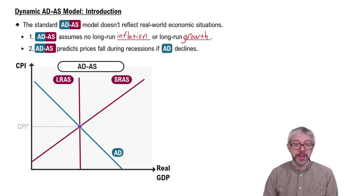
 04:59
04:59