Skip to main content
Macroeconomics
Il mio corso
Impara
Preparazione agli esami
AI Tutor
Guide di studio
Flashcard
Esplora
Prova l'app
Il mio corso
Impara
Preparazione agli esami
AI Tutor
Guide di studio
Flashcard
Esplora
Prova l'app
Indietro
Elasticity Summary quiz
Puoi toccare per girare la carta.
What is the formula for price elasticity of demand?
Puoi toccare per girare la carta.
👆
What is the formula for price elasticity of demand?
Price elasticity of demand is calculated as the percentage change in quantity demanded divided by the percentage change in price.
Avanzamenti del tracciato
I pulsanti di controllo sono stati cambiati in modalità "navigazione".
1/15
Flashcard correlate
Pratica correlata
Video consigliati
Elasticity Summary definitions
Elasticity Summary
15 Termini
Elasticity Summary
4. Elasticity
9 Problemi
Argomento
Price Elasticity of Supply on a Graph
4. Elasticity
10 Problemi
Argomento
4. Elasticity - Part 1 of 2
10 Argomenti
15 Problemi
Capitolo
4. Elasticity - Part 2 of 2
1 Argomento
3 Problemi
Capitolo
VideoThumbView.guidedCourse
04:06
Elasticity Summary
3829
views
28
rank
Termini in questo insieme (15)
Nascondere definizioni
What is the formula for price elasticity of demand?
Price elasticity of demand is calculated as the percentage change in quantity demanded divided by the percentage change in price.
When calculating price elasticity of demand or supply, why do we use absolute values?
We use absolute values to ensure the elasticity result is always positive, regardless of the direction of change.
What does a price elasticity value greater than 1 indicate?
A value greater than 1 indicates that demand or supply is elastic.
What are the two variables used in the price elasticity of supply formula?
The two variables are quantity supplied and price.
How do you calculate income elasticity of demand?
Income elasticity of demand is calculated as the percentage change in quantity demanded divided by the percentage change in income.
Why is the sign (positive or negative) important for income elasticity and cross-price elasticity?
The sign determines the type of good: positive for normal goods or substitutes, negative for inferior goods or complements.
What does a positive cross-price elasticity indicate?
A positive cross-price elasticity indicates that the two goods are substitutes.
What does a negative cross-price elasticity indicate?
A negative cross-price elasticity indicates that the two goods are complements.
What is the midpoint method used for in elasticity calculations?
The midpoint method is used to calculate percentage changes by averaging the starting and ending values, making elasticity calculations more accurate.
At what point on a straight-line demand curve is total revenue maximized?
Total revenue is maximized at the point where demand is unit elastic.
How does total revenue change if price increases and demand is inelastic?
If demand is inelastic, an increase in price leads to an increase in total revenue.
How does total revenue change if price increases and demand is elastic?
If demand is elastic, an increase in price leads to a decrease in total revenue.
What step should you always remember when calculating income or cross-price elasticity?
You should always check the sign of the result to determine the type of good or relationship.
What does it mean if the income elasticity of demand is negative?
A negative income elasticity means the good is an inferior good.
What are the two variables used in the cross-price elasticity of demand formula?
The two variables are the percentage change in quantity demanded of one good and the percentage change in price of another good.
 IndietroIndietro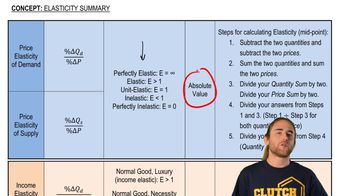
 04:06
04:06