Skip to main content
Macroeconomics
Il mio corso
Impara
Preparazione agli esami
AI Tutor
Guide di studio
Flashcard
Esplora
Prova l'app
Il mio corso
Impara
Preparazione agli esami
AI Tutor
Guide di studio
Flashcard
Esplora
Prova l'app
Indietro
Kinked-Demand Theory definitions
Puoi toccare per girare la carta.
Oligopoly
Puoi toccare per girare la carta.
👆
Oligopoly
A market structure with a few dominant firms whose pricing and output decisions are interdependent due to mutual awareness.
Avanzamenti del tracciato
I pulsanti di controllo sono stati cambiati in modalità "navigazione".
1/15
Flashcard correlate
Video consigliati
Kinked-Demand Theory quiz
Kinked-Demand Theory
15 Termini
VideoThumbView.guidedCourse
13:04
Oligopoly:Kinked Demand Theory
4
views
Termini in questo insieme (15)
Nascondere definizioni
Oligopoly
A market structure with a few dominant firms whose pricing and output decisions are interdependent due to mutual awareness.
Kinked Demand Curve
A graphical representation showing two distinct slopes, reflecting rivals' tendency to match price cuts but ignore price hikes.
Price Inflexibility
A situation where firms are reluctant to change prices due to uncertain or disadvantageous competitor reactions.
Marginal Revenue Curve
A curve with a discontinuity at the kink, indicating abrupt changes in additional revenue from selling one more unit.
Marginal Cost
The expense of producing one more unit, which can shift without affecting output or price within a certain range in this model.
Demand Elasticity
A measure of how quantity demanded responds to price changes, varying above and below the kink in the curve.
Game Theory
An analytical tool for predicting rival firms' strategic responses to price changes in interdependent markets.
Interdependence
A condition where each firm's actions directly influence and are influenced by the decisions of competitors.
Profit Maximization
The process of choosing output and price to achieve the highest possible earnings, complicated by rivals' reactions.
Market Structure
The organizational and competitive characteristics of a market, shaping firm behavior and outcomes.
Price Decrease
A reduction in selling price, typically matched by rivals, resulting in minimal competitive advantage.
Price Increase
A rise in selling price, often ignored by rivals, causing significant loss of customers to competitors.
Stable Prices
A tendency for prices to remain unchanged over time, even with shifts in costs, due to strategic firm interactions.
Discontinuity
A break or gap in the marginal revenue curve, reflecting the abrupt change in slope at the kink.
Quantity Exchanged
The amount of goods sold, which responds differently to price changes depending on competitor reactions.
 IndietroIndietro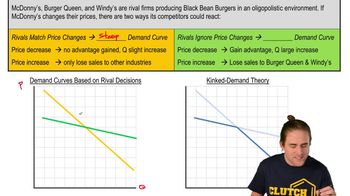
 13:04
13:04