Skip to main content
Macroeconomics
Il mio corso
Impara
Preparazione agli esami
AI Tutor
Guide di studio
Flashcard
Esplora
Prova l'app
Il mio corso
Impara
Preparazione agli esami
AI Tutor
Guide di studio
Flashcard
Esplora
Prova l'app
Indietro
New Classical Model definitions
Puoi toccare per girare la carta.
New Classical Model
Puoi toccare per girare la carta.
👆
New Classical Model
A framework emphasizing flexible prices and wages, rational expectations, and a tendency toward full employment and potential GDP.
Avanzamenti del tracciato
I pulsanti di controllo sono stati cambiati in modalità "navigazione".
1/15
Flashcard correlate
Pratica correlata
Video consigliati
New Classical Model quiz
New Classical Model
15 Termini
New Classical Model
22. Macroeconomic Schools of Thought
9 Problemi
Argomento
Real Business Cycle Model
22. Macroeconomic Schools of Thought
10 Problemi
Argomento
24. Macroeconomic Schools of Thought
7 Argomenti
15 Problemi
Capitolo
VideoThumbView.guidedCourse
04:33
New Classical Model
1284
views
7
rank
Termini in questo insieme (15)
Nascondere definizioni
New Classical Model
A framework emphasizing flexible prices and wages, rational expectations, and a tendency toward full employment and potential GDP.
Classical Model
An economic approach predating the Great Depression, highlighting full employment and resource utilization with minimal government intervention.
Keynesian Model
A theory focusing on sticky prices and wages, advocating government intervention to address recessions and inflation.
Potential GDP
The output level where all resources are fully employed, representing the economy's sustainable production capacity.
Full Employment
A situation where all available labor resources are in use, with unemployment only due to normal job transitions.
Flexible Prices
A condition where market prices adjust rapidly to changes in supply and demand, preventing prolonged shortages or surpluses.
Flexible Wages
A scenario where compensation adjusts quickly in response to economic shifts, allowing labor markets to clear efficiently.
Sticky Prices
A characteristic where prices are slow to change, often causing imbalances during economic fluctuations.
Sticky Wages
A situation where worker pay does not adjust quickly, often due to contracts or institutional factors.
Rational Expectations
An assumption that economic agents use all available information to forecast future variables, especially inflation.
Expected Inflation
The anticipated rate at which prices will rise, influencing current economic decisions by firms and workers.
Actual Inflation
The realized rate of price increases, which may differ from what was previously anticipated.
Short Run Phillips Curve
A graphical representation showing the inverse relationship between inflation and unemployment in the short term.
Monetary Growth Rule
A policy advocating steady, predictable increases in the money supply to stabilize expectations about inflation.
Money Supply
The total amount of monetary assets available in an economy, influencing inflation and economic activity.
 IndietroIndietro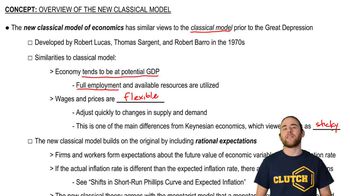
 04:33
04:33