Skip to main content
Macroeconomics
Il mio corso
Impara
Preparazione agli esami
AI Tutor
Guide di studio
Flashcard
Esplora
Prova l'app
Il mio corso
Impara
Preparazione agli esami
AI Tutor
Guide di studio
Flashcard
Esplora
Prova l'app
Indietro
New Growth Theory definitions
Puoi toccare per girare la carta.
New Growth Theory
Puoi toccare per girare la carta.
👆
New Growth Theory
A framework highlighting technology and knowledge as primary drivers of long-term economic expansion, emphasizing innovation over traditional capital.
Avanzamenti del tracciato
I pulsanti di controllo sono stati cambiati in modalità "navigazione".
1/15
Flashcard correlate
Pratica correlata
Video consigliati
New Growth Theory quiz
New Growth Theory
15 Termini
New Growth Theory
12. Productivity and Economic Growth
10 Problemi
Argomento
PPF - Growth Analysis
12. Productivity and Economic Growth
10 Problemi
Argomento
13. Productivity and Economic Growth
6 Argomenti
14 Problemi
Capitolo
VideoThumbView.guidedCourse
06:15
New Growth Theory
1768
views
42
rank
Termini in questo insieme (15)
Nascondere definizioni
New Growth Theory
A framework highlighting technology and knowledge as primary drivers of long-term economic expansion, emphasizing innovation over traditional capital.
Technology
Advancements or innovations that boost productivity and enable higher output without increasing traditional inputs.
Productivity
The efficiency with which inputs are transformed into outputs, often enhanced by technological improvements.
Knowledge Capital
The collective stock of information, ideas, and technology available within an economy, distinct from skills or education.
Human Capital
The skills, education, and abilities possessed by individuals, which enhance their capacity to contribute to economic activity.
Physical Capital
Tangible assets like machinery, buildings, and equipment used in production, subject to diminishing returns.
Research and Development
Activities undertaken by firms to innovate, discover new technologies, and expand the pool of knowledge capital.
Diminishing Returns
A phenomenon where each additional unit of input yields progressively smaller increases in output, typical for physical capital.
Increasing Returns
A situation where the benefits from additional input, such as knowledge, grow larger as more is accumulated and shared.
Public Good
A resource that is non-rival and non-excludable, allowing multiple users to benefit without reducing its availability to others.
Non-rivalry
A characteristic where one individual's use of a resource does not diminish its availability for others.
Non-excludability
A feature of resources that cannot be withheld from those who have not paid for them, making exclusion impractical.
Patent
A legal protection granting exclusive rights to an invention for a limited period, typically 20 years, to encourage innovation.
Subsidy
Financial support from the government to encourage activities like research and development or education.
Free Riding
Benefiting from resources, goods, or services without directly contributing to their creation or cost, common with public goods.
 IndietroIndietro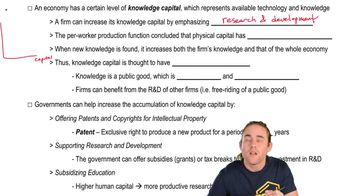
 06:15
06:15