Skip to main content
Macroeconomics
Il mio corso
Impara
Preparazione agli esami
AI Tutor
Guide di studio
Flashcard
Esplora
Prova l'app
Il mio corso
Impara
Preparazione agli esami
AI Tutor
Guide di studio
Flashcard
Esplora
Prova l'app
Indietro
Quantity Theory of Money definitions
Puoi toccare per girare la carta.
Quantity Theory of Money
Puoi toccare per girare la carta.
👆
Quantity Theory of Money
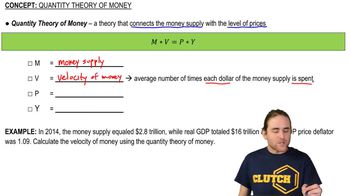
A framework linking the amount of money in circulation to overall price levels using a simple mathematical relationship.
Avanzamenti del tracciato
I pulsanti di controllo sono stati cambiati in modalità "navigazione".
1/13
Flashcard correlate
Pratica correlata
Video consigliati
Quantity Theory of Money quiz #1
Quantity Theory of Money
10 Termini
Quantity Theory of Money
18. Monetary Policy
10 Problemi
Argomento
Federal Reserve Policies during the 2007-2009 Recession
18. Monetary Policy
10 Problemi
Argomento
19. Monetary Policy
8 Argomenti
14 Problemi
Capitolo
VideoThumbView.guidedCourse
05:17
Quantity Theory of Money and Inflation
1686
views
23
rank
VideoThumbView.guidedCourse
04:25
Quantity Theory of Money
1932
views
13
rank
Termini in questo insieme (13)
Nascondere definizioni
Quantity Theory of Money
A framework linking the amount of money in circulation to overall price levels using a simple mathematical relationship.
Money Supply
The total amount of currency available in an economy, typically regulated by a central authority like the Fed.
Velocity of Money
The average number of times each unit of currency is spent on goods and services within a year.
Price Level
A measure reflecting the average of current prices for goods and services compared to a base year.
Real GDP
The total value of all goods and services produced, adjusted to remove the effects of price changes over time.
Price Deflator
An index used to adjust nominal GDP to real GDP by accounting for changes in price levels.
Inflation
A sustained increase in the general price level, often resulting from money supply growth outpacing real GDP.
Deflation
A general decline in prices, typically occurring when real GDP grows faster than the money supply.
Stable Prices
A situation where the overall price level remains unchanged due to equal growth rates in money supply and real GDP.
Equation of Exchange
A mathematical identity expressing the relationship among money supply, velocity, price level, and real GDP.
Base Year
A reference period used for comparison when measuring changes in price levels or economic output.
Mathematical Identity
A relationship that holds true by definition, such as the equality in the equation connecting money, velocity, prices, and output.
Central Authority
An institution, like the Federal Reserve, responsible for regulating the amount of currency in the economy.
 IndietroIndietro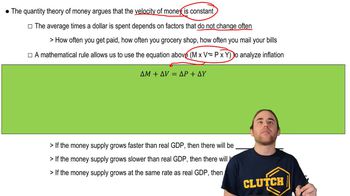
 05:17
05:17