Skip to main content
Macroeconomics
Il mio corso
Impara
Preparazione agli esami
AI Tutor
Guide di studio
Flashcard
Esplora
Prova l'app
Il mio corso
Impara
Preparazione agli esami
AI Tutor
Guide di studio
Flashcard
Esplora
Prova l'app
Indietro
Real Business Cycle Model definitions
Puoi toccare per girare la carta.
Real Business Cycle Model
Puoi toccare per girare la carta.
👆
Real Business Cycle Model
A framework emphasizing economic fluctuations driven by shifts in aggregate supply, especially from technology or resource changes.
Avanzamenti del tracciato
I pulsanti di controllo sono stati cambiati in modalità "navigazione".
1/15
Flashcard correlate
Pratica correlata
Video consigliati
Real Business Cycle Model quiz
Real Business Cycle Model
15 Termini
Real Business Cycle Model
22. Macroeconomic Schools of Thought
10 Problemi
Argomento
Austrian Model
22. Macroeconomic Schools of Thought
10 Problemi
Argomento
24. Macroeconomic Schools of Thought
7 Argomenti
15 Problemi
Capitolo
VideoThumbView.guidedCourse
03:54
Real Business Cycle Model
1129
views
11
rank
Termini in questo insieme (15)
Nascondere definizioni
Real Business Cycle Model
A framework emphasizing economic fluctuations driven by shifts in aggregate supply, especially from technology or resource changes.
Aggregate Supply
The total output producers are willing and able to supply at various price levels, central to explaining economic cycles in this model.
Aggregate Demand
The total spending on goods and services in an economy, which shifts in response to changes in production and income.
Supply Shock
A sudden event, like a spike in input costs or resource scarcity, that disrupts production and shifts aggregate supply.
Long Run Aggregate Supply
A curve representing the economy's maximum sustainable output, which can shift due to resource or technology changes.
Equilibrium
A state where aggregate supply and aggregate demand intersect, determining the economy's output and price level.
Price Level
An index reflecting the average prices of goods and services, which may remain stable even as output changes in this model.
Recession
A period marked by reduced production and employment, often triggered by negative supply shocks in this framework.
Inflation
A general rise in prices, attributed here mainly to supply-side factors like resource costs or technological shifts.
Resource Availability
The accessibility of inputs needed for production, whose changes can cause major shifts in economic output.
Production Capacity
The maximum output an economy can sustain, which declines when resources become scarce or technology regresses.
Input Prices
The costs of resources used by firms, where increases can reduce supply and trigger economic downturns.
Technological Change
Advancements or setbacks in methods of production, seen as a primary driver of supply-side economic fluctuations.
Employment
The level of labor utilization, which falls when production drops due to adverse supply conditions.
GDP
The total value of goods and services produced, which contracts following negative supply shocks in this model.
 IndietroIndietro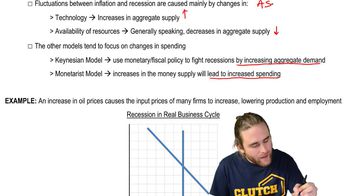
 03:54
03:54