Skip to main content
Macroeconomics
Il mio corso
Impara
Preparazione agli esami
AI Tutor
Guide di studio
Flashcard
Esplora
Prova l'app
Il mio corso
Impara
Preparazione agli esami
AI Tutor
Guide di studio
Flashcard
Esplora
Prova l'app
Indietro
Supply and Demand Together: One-sided Shifts definitions
Puoi toccare per girare la carta.
Equilibrium Price
Puoi toccare per girare la carta.
👆
Equilibrium Price
The market value where the quantity consumers want equals the quantity producers offer, found at the intersection of supply and demand curves.
Avanzamenti del tracciato
I pulsanti di controllo sono stati cambiati in modalità "navigazione".
1/15
Flashcard correlate
Pratica correlata
Video consigliati
Supply and Demand Together: One-sided Shifts quiz
Supply and Demand Together: One-sided Shifts
15 Termini
Supply and Demand Together: One-sided Shifts
3. Supply and Demand
10 Problemi
Argomento
Supply and Demand Together: Both Shift
3. Supply and Demand
10 Problemi
Argomento
3. Supply and Demand - Part 1 of 2
11 Argomenti
15 Problemi
Capitolo
3. Supply and Demand - Part 2 of 2
1 Argomento
3 Problemi
Capitolo
VideoThumbView.guidedCourse
04:26
Demand Shifts
471
views
9
rank
VideoThumbView.guidedCourse
03:36
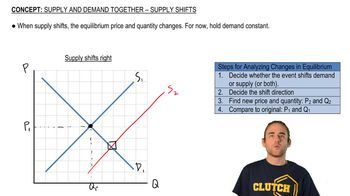
Supply Shifts
3131
views
39
rank
Termini in questo insieme (15)
Nascondere definizioni
Equilibrium Price
The market value where the quantity consumers want equals the quantity producers offer, found at the intersection of supply and demand curves.
Equilibrium Quantity
The amount exchanged in a market when supply and demand are balanced, located at the intersection point of both curves.
Demand Curve
A graphical representation showing the relationship between price and the quantity consumers are willing to buy.
Supply Curve
A graphical line illustrating how much producers are willing to offer at various prices.
Rightward Shift
A movement of a curve indicating an increase, such as more demand or greater supply at every price.
Leftward Shift
A movement of a curve indicating a decrease, such as less demand or reduced supply at every price.
Determinant
A factor that causes a curve to move, such as consumer preferences or input costs.
Input Cost
The expense of resources used in production, which can affect the position of the supply curve.
Technological Advancement
An improvement in production methods that enables more output at lower cost, shifting supply right.
Complementary Good
A product whose price change can influence the demand for another related product.
Graphical Analysis
The use of visual tools to track and compare changes in market outcomes after shifts in curves.
Intersection Point
The spot on a graph where supply and demand meet, indicating market balance.
Labeling
The practice of clearly marking axes, curves, and points to avoid confusion in graphical work.
Market Outcome
The resulting price and quantity after considering shifts in supply or demand.
Consumer Preference
A determinant reflecting changes in buyers’ tastes, which can shift the demand curve.
 IndietroIndietro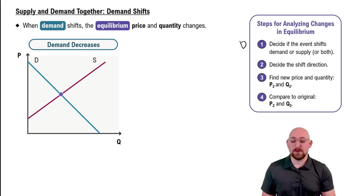
 04:26
04:26