Skip to main content
Macroeconomics
Il mio corso
Impara
Preparazione agli esami
AI Tutor
Guide di studio
Flashcard
Esplora
Prova l'app
Il mio corso
Impara
Preparazione agli esami
AI Tutor
Guide di studio
Flashcard
Esplora
Prova l'app
Indietro
Time Value of Money Calculations quiz
Puoi toccare per girare la carta.
Why is money considered more valuable today than in the future?
Puoi toccare per girare la carta.
👆
Why is money considered more valuable today than in the future?
Because you can invest money today and earn interest, making it worth more in the future.
Avanzamenti del tracciato
I pulsanti di controllo sono stati cambiati in modalità "navigazione".
1/15
Flashcard correlate
Pratica correlata
Video consigliati
Time Value of Money Calculations definitions
Time Value of Money Calculations
13 Termini
Time Value of Money Calculations
13. The Financial System
9 Problemi
Argomento
Calculating Bond and Stock Prices
13. The Financial System
5 Problemi
Argomento
14. The Financial System - Part 1 of 2
8 Argomenti
15 Problemi
Capitolo
13. The Financial System - Part 2 of 2
1 Argomento
3 Problemi
Capitolo
VideoThumbView.guidedCourse
06:28
Time Value of Money Calculations
1435
views
8
rank
Termini in questo insieme (15)
Nascondere definizioni
Why is money considered more valuable today than in the future?
Because you can invest money today and earn interest, making it worth more in the future.
What are the two main concepts related to the time value of money?
The two main concepts are compounding and discounting.
What does compounding mean in the context of the time value of money?
Compounding means earning interest on both the initial principal and the accumulated interest over time.
What is discounting in time value of money calculations?
Discounting is determining the present value of money to be received in the future by removing interest.
What is the fundamental equation for the time value of money?
The equation is FV = PV * (1 + r)^n.
In the equation FV = PV * (1 + r)^n, what does FV stand for?
FV stands for future value, which is the amount of money at a future date.
What does PV represent in the time value of money equation?
PV represents present value, or the amount of money today.
How is the interest rate represented in the time value of money formula?
The interest rate is represented by 'r' and is expressed as a decimal.
What does 'n' represent in the formula FV = PV * (1 + r)^n?
'n' is the number of periods, usually years, over which the money is invested or discounted.
If you invest \$100 at 10% interest for 3 years, which concept are you applying?
You are applying compounding, as you are calculating the future value of present money.
What tool is helpful for visualizing cash flows in time value of money problems?
A timeline is helpful for visualizing cash flows over different periods.
When using the time value of money equation, what must be provided in the problem?
The interest rate (r) and the number of periods (n) must be given.
How do you express a 10% interest rate in the time value of money formula?
You express it as 0.10 in the formula.
Which process involves finding out what a present amount of money will be worth in the future?
This process is called compounding.
If you want to know the value today of \$1,000 to be received in 5 years, which process do you use?
You use discounting to find its present value.
 IndietroIndietro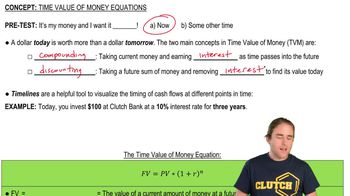
 06:28
06:28