Indietro

Chapter 1 Cards

I pulsanti di controllo sono stati cambiati in modalità "navigazione".
1/19
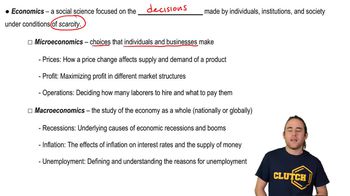
  • What is the primary focus of economics?

    Economics studies how people make choices and respond to scarcity, focusing on what they buy, how much education they get, and other decisions.
  • How does economics differ from other social sciences?

    Economics uniquely focuses on choices people make and the incentives they face, such as prices and social consequences.
  • What is the difference between microeconomics and macroeconomics?

    Microeconomics studies individual people, businesses, and industries, while macroeconomics studies national and global economies.
  • What are goods and services in economics?

    Goods are physical items people value; services are tasks performed for people, both usually involving payment.
  • What are the four factors of production?

    Land (natural resources), labor (human effort), capital (tools and machines), and entrepreneurship (organizing resources to create value).
  • How is income generated from factors of production?

    Land earns rent, labor earns wages, capital earns interest, and entrepreneurship earns profit.
  • What is the economic meaning of 'self-interested'?

    Acting based on personal preferences and available options to make the best decision for oneself, not necessarily selfish.
  • What is social interest in economics?

    The best possible outcome for society as a whole, often involving efficiency and fairness considerations.
  • How do economists define efficiency?

    A situation is efficient if it is impossible to make someone better off without making someone else worse off.
  • Why might an efficient outcome not be considered socially desirable?

    Because efficiency does not address fairness or distribution of benefits, which may lead to inequality.
  • What is the difference between 'selfish' and 'self-interested'?

    'Selfish' implies disregard for others, while 'self-interested' means making rational choices based on personal benefit.
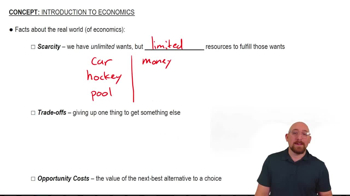
  • What is a tradeoff in economics?

    Every choice involves giving up something else due to scarcity, meaning choosing one option over another.
  • What is rational choice theory?

    The assumption that individuals consider all options and select the one that best satisfies their preferences.
  • How is 'benefit' defined in economics?

    Benefit is the pleasure or satisfaction gained from something, which varies by individual and is not the same as price.
  • What is opportunity cost?

    The highest-valued alternative that must be given up to obtain something.
  • What does 'making decisions at the margin' mean?

    Considering the additional benefit or cost of one more unit of something before making a decision.
  • How do incentives influence choices?

    People respond to incentives by changing their behavior when the costs or benefits of actions change.
  • What is the difference between positive and normative statements?

    Positive statements are factual and testable, while normative statements express opinions about what ought to be.
  • How do economists use models in policy advice?

    Economists use models to analyze positive statements and help determine the best ways to achieve societal goals.