Real GDP per capita measures the standard of living.
What is the Rule of 70?
The Rule of 70 estimates the number of years it takes for a variable to double: \(\text{Years to Double} = \frac{70}{\text{Growth Rate}}\).
What primarily drives increases in real GDP per capita?
Increases in real GDP per capita depend on increases in labor productivity, which depends on capital per worker and technology, with technology being the most important.
Define labor productivity.
Labor productivity is the quantity of goods and services produced by one worker or one hour of work.
What is potential GDP?
Potential GDP is the level of real GDP when all firms produce at capacity, using normal hours and workforce.
How does potential GDP change over time?
Potential GDP increases as the labor force grows, new machinery and equipment are installed, and technological change occurs.
What is the role of the financial system in economic growth?
The financial system provides funds for investment projects like capital equipment, training workers, new technologies, and R&D.
What are the two main components of the financial system?
The financial system consists of financial markets and financial intermediaries.
How does the financial system channel funds?
It channels funds from savers to borrowers and returns on borrowed funds back to savers.
What are the two phases of the business cycle?
The two phases are expansion and recession.
What are the two turning points in the business cycle?
The two turning points are the peak and the trough.
What is the sequence of the business cycle phases?
The sequence is: Expansion, Peak, Recession, Trough.
How is a recession defined?
A recession is a significant decline in economic activity spread across the country, lasting more than a few months.
How does inflation typically behave during the business cycle?
Inflation usually increases during expansions and decreases during recessions.
How does unemployment typically behave during the business cycle?
Unemployment usually decreases during expansions and increases during recessions, except at the start of expansions.
Why does unemployment often rise at the beginning of an expansion?
Because discouraged workers reenter the labor force and firms operate below capacity, so hiring is slow.
What was the increase in U.S. real GDP per capita from 1900 to 2022?
Real GDP per capita increased from about \$6,764 in 1900 to \$65,415 in 2022, more than a 9-fold increase.
What percentage of U.S. homes had electricity, running water, and indoor flush toilets in 1900?
In 1900, 9% had electricity, 3% had running water, and 0% had indoor flush toilets.
What is the significance of the financial system to individuals?
It provides access to student loans, mortgages, and business loans, enabling education, homeownership, and business investment.
What happens to firms during a recession in terms of capacity and hiring?
Firms operate below capacity and are slow to hire, sometimes continuing layoffs.
 Indietro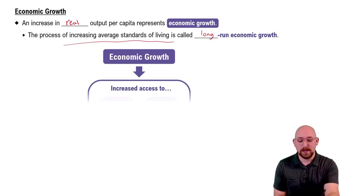
 02:07
02:07