Indietro

Chapter 12

I pulsanti di controllo sono stati cambiati in modalità "navigazione".
1/24
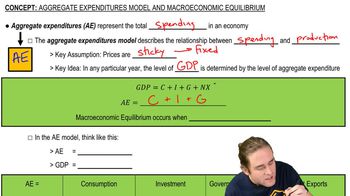
  • What determines the level of GDP in any particular year according to the Aggregate Expenditure Model?

    The level of GDP is determined by the level of total spending (aggregate expenditure).
  • What causes changes in real GDP and employment in the short run?

    Changes in total spending cause changes in real GDP and employment in the short run.
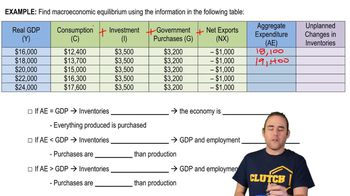
  • What happens if total spending is less than total production (real GDP)?

    Inventories increase, leading to a decrease in total production and employment.
  • What happens if total spending is greater than total production (real GDP)?

    Inventories decrease, leading to an increase in total production and employment.
  • What assumptions does the Aggregate Expenditure (AE) model make about potential GDP and prices?

    The AE model assumes potential GDP is fixed and prices are fixed.
  • What type of unemployment does the AE model explain?

    The AE model explains cyclical unemployment related to short-run business cycle fluctuations.
  • What is macroeconomic equilibrium in the AE model?

    It occurs where planned aggregate expenditure (AE) equals total production (real GDP).
  • What signals whether firms should increase or decrease production and employment?

    Unintended inventories, calculated as real GDP minus aggregate expenditure, signal production adjustments.
  • List the four factors that determine consumption spending (C).

    Current disposable income (+), household wealth (+), expected future income (+), and interest rate (-).
  • How does the interest rate affect consumption spending?

    Higher interest rates increase saving, decrease consumption, and raise borrowing costs for durable goods.
  • What are the three factors that determine investment spending (I)?

    Expectations of future profitability (+), interest rate (-), and business taxes (-).
  • How do business taxes affect investment spending?

    A reduction in corporate income tax increases after-tax profitability, increasing investment spending.
  • What determines net exports (NX)?

    Growth rate of foreign real GDP (+) and the exchange rate between the dollar and other currencies (-).
  • How does an increase in foreign real GDP affect U.S. net exports?

    It increases foreign demand for U.S. exports, raising net exports.
  • What is the effect of an appreciation of the dollar on net exports?

    An appreciation raises the cost of U.S. exports and lowers the cost of imports, decreasing net exports.
  • Where does macroeconomic equilibrium occur graphically in the AE model?

    At the intersection of the planned aggregate expenditure (AE) line and the 45° line where AE = real GDP.
  • What shifts the AE line and changes equilibrium real GDP?

    Changes in autonomous expenditure (variables other than current income affecting C, I, G, or NX).
  • What is the multiplier effect in macroeconomics?

    The process by which a change in autonomous expenditure leads to a larger change in real GDP.
  • Write the formula for the multiplier.

    Multiplier = \(\frac{1}{1-MPC}\), where MPC is the marginal propensity to consume.
  • How does the marginal propensity to consume (MPC) affect the multiplier?

    The larger the MPC, the larger the multiplier and the greater the change in real GDP from autonomous spending.
  • What happens to real GDP if net exports rise by \$100 billion and MPC = 0.8?

    Real GDP increases by \$500 billion, calculated as \(100 billion × \(\frac{1}{1-0.8}\) = \)500 billion.
  • Why can a decline in spending on residential construction cause widespread recession effects?

    Because of the multiplier effect, initial spending declines reduce income and consumption broadly, affecting many industries.
  • What does 'inventory drawdown' mean and how does it affect GDP?

    Inventory drawdown is a reduction in inventories, signaling firms to reduce production, which contributes to GDP decline.
  • How do planned and unplanned inventory changes affect the business cycle?

    Planned inventory increases reflect expected demand, while unplanned changes signal production adjustments affecting GDP.