 Indietro
Chapter 8 Study Guide
 02:31
02:31
Termini in questo insieme (20)
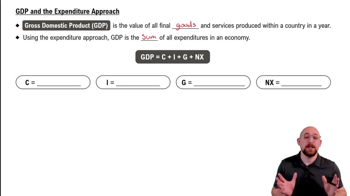
GDP is the market value of all final goods and services produced within a country during a year.
GDP = Total Production = Total Income. The value of production equals the income earned by factors of production.
Consumption (C), Investment (I), Government Purchases (G), and Net Exports (NX).
Household production and the underground economy (illegal or unreported market activity) are excluded.
GDP excludes the value of leisure, is not adjusted for pollution or social problems, and does not measure income distribution.
Nominal GDP is valued at current-year prices; Real GDP is valued at base-year prices, adjusting for inflation.
GDI measures the economy's output from the income side and theoretically equals GDP, but differences arise due to measurement errors.
The Gini index measures income inequality; 0 means perfect equality, 100 means perfect inequality.
Spending by households on services, nondurable goods, and durable goods, making up about 68% of GDP.
Spending by firms on new factories, machinery, office buildings, additions to inventories, and households on new houses.
Spending by federal, state, and local governments on goods and services like teachers' salaries and infrastructure.
Net exports = Exports (goods/services produced domestically and sold abroad) minus imports (goods/services produced abroad and bought domestically).
Because nominal GDP includes inflation, it can increase even if actual production does not.
Real GDP removes the effects of inflation by valuing output at constant base-year prices.
Yes, if prices rise enough to offset the decrease in quantity.
No, real GDP reflects actual production quantities adjusted for inflation.
Wages, rent, interest, and profit.
GDP measures the total economic output (size of the pie), but not how income is distributed among people.
Goods and services produced and consumed within a household, not sold in markets, and thus excluded from GDP.
Economic activity involving buying and selling goods and services concealed from the government to avoid taxes or regulations.