 Indietro
Macroeconomics Fundamentals and Economic Thinking
 04:30
04:30
Termini in questo insieme (28)
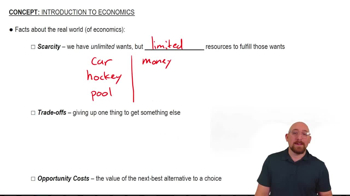
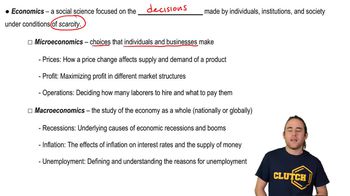
Scarcity is the fundamental economic problem where wants exceed available resources, forcing choices on how to allocate limited resources.
Macroeconomics studies the overall performance of national and global economies, including topics like unemployment rates and monetary policy effects.
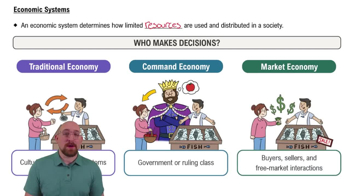
What goods and services to produce, how to produce them, and for whom they are produced.
Land (natural resources), Labor (work effort), Capital (tools and machines), and Entrepreneurship (organizing resources and bearing risks).
Opportunity cost is the highest-valued alternative given up to obtain something.
Marginal benefit is the additional gain from one more unit of an activity; marginal cost is the additional cost of that unit. Decisions are made by comparing these.
Making a choice by comparing benefits and costs to maximize net benefit according to individual preferences.
Incentives are rewards or penalties that encourage or discourage behaviors, influencing self-interested choices.
Positive statements describe what is and can be tested; normative statements describe what ought to be and are based on values.
Every choice involves a tradeoff, meaning giving up something to gain something else.
Economic models are simplified descriptions focusing on key features to explain and predict economic behavior.
The slope is the ratio of the change in the y-variable to the change in the x-variable, calculated as \(\frac{\Delta y}{\Delta x}\).
A positive slope means two variables move in the same direction; as one increases, the other also increases.
A negative slope means two variables move in opposite directions; as one increases, the other decreases.
Ceteris paribus means holding all other relevant factors constant to isolate the effect of one variable.
Movement along a curve is caused by a change in the variable on the axis; a shift of the curve occurs when other factors change.
Human capital is the knowledge and skills gained through education and experience that improve labor quality.
Efficiency means resources are used so that no one can be made better off without making someone else worse off.
Entrepreneurship organizes land, labor, and capital, drives progress, makes business decisions, and bears risks.
Scatter diagrams plot values of two variables to reveal relationships like positive, negative, or no correlation.
The linear equation is \(y=a+bx\), where a is the y-intercept and b is the slope.
Land earns rent, labor earns wages, capital earns interest, and entrepreneurship earns profit.
Proper incentives encourage individuals' self-interested choices to also benefit society as a whole.
Goods are physical objects; services are tasks performed for people.
Decisions are made by comparing marginal benefits and marginal costs to optimize outcomes.
Globalization benefits consumers and firms but may harm local workers; its social interest impact is debated.
Economists use economic tools to advise governments and businesses on efficient resource use and policy decisions.
Critical thinking, analytical skills, math, writing, and oral communication are key skills for economics careers.