 Indietro
Macroeconomics Key Concepts and Principles
 02:08
02:08
Termini in questo insieme (20)
Scarcity means resources used to produce goods and services are limited while wants are unlimited, forcing choices and trade-offs.
Opportunity cost is what you sacrifice to get something, representing the next best alternative foregone.
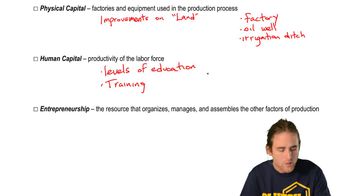
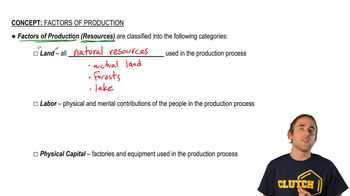
Resources used to produce goods and services: natural resources, labor, physical capital, human capital, and entrepreneurship.
Human capital is the knowledge and skills acquired by a worker through education and experience used to produce goods and services.
Positive analysis answers "what is" using facts; normative analysis answers "what ought to be" based on opinions or values.
What products do we produce? How do we produce them? Who consumes the products?
An economic model is a simplified representation of an economic environment, often using graphs to explain relationships.
Ceteris paribus means holding other variables fixed to isolate the effect of one variable on another.
A marginal change is a small, one-unit incremental change in a variable.
Increase an activity as long as its marginal benefit exceeds or equals its marginal cost.
The PPC shows possible combinations of two products an economy can produce using all resources efficiently.
A voluntary exchange makes both parties better off because each values what they receive more than what they give.
Increasing one input while holding others fixed eventually leads to smaller increases in output beyond a certain point.
People care about the real value (purchasing power) of money, not its nominal value (face value).
Specialization is when individuals or nations focus on producing what they do best to increase efficiency.
Entrepreneurship coordinates natural resources, labor, physical capital, and human capital to produce and sell products.
Marginal benefit decreases with each sequel as revenue falls, while marginal cost increases due to higher actor salaries.
Assumptions simplify complex realities to focus on key relationships and make analysis manageable.
A variable is a measurable factor that can take on different values and affect economic outcomes.
By lowering interest rates to historic lows to encourage spending and later raising them to prevent inflation.