 Indietro
Ten Big Ideas in Economics - Macroeconomics Principles
 09:36
09:36
Termini in questo insieme (18)
Scarcity is the limited nature of society’s resources, requiring choices about how to allocate them.
Economics is the study of how society manages its scarce resources, including decisions by individuals, firms, and governments.
A tradeoff means giving up one thing to get something else, as all decisions involve sacrificing alternatives.
Efficiency means maximizing resource use; equality means distributing prosperity uniformly. Improving one often reduces the other.
Opportunity cost is what you give up to get something, including the value of the next best alternative.
Rational people make decisions by comparing costs and benefits of marginal changes, making incremental adjustments to plans.
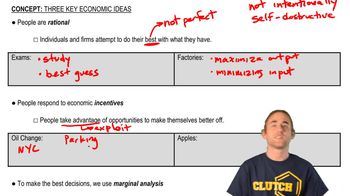
Incentives are rewards or punishments that motivate people to act; rational people respond to incentives.
Because only the marginal cost and benefit of fixing the transmission (\$600 cost vs. increased value) matter for the decision.
Trade allows specialization, letting people and countries produce what they do best and exchange for other goods, increasing overall welfare.
A market is a group of buyers and sellers that organize economic activity by determining what, how, and for whom goods are produced.
The invisible hand describes how self-interested households and firms, through market prices, promote general economic well-being.
Prices reflect a good’s value to buyers and production cost, guiding households and firms to allocate resources efficiently.
Market failure occurs when markets fail to allocate resources efficiently, often due to externalities or market power.
Productivity is output per unit of labor; it is the key determinant of living standards and economic prosperity.
Productivity depends on equipment, skills, education, and technology available to workers.
Inflation is caused by excessive growth in the money supply, which reduces the value of money and raises prices.
The business cycle refers to irregular fluctuations in economic activity, including booms and busts.
Monetary and fiscal policies are used to smooth out the ups and downs of the business cycle.