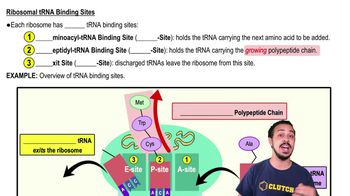
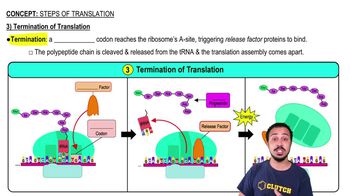
Codons are ___________ nucleotides long and are in ___________, which is transcribed from DNA. During ___________, tRNAs serve as adapter molecules to bring ___________ to the ribosome to build a protein. Once the ribosome reaches a(n) ___________ on the mRNA, translation ends.
Guida verificata passo dopo passo
1
Identify the length of codons: Codons are sequences of nucleotides that specify amino acids. Each codon consists of 3 nucleotides, so the first blank is filled with '3'.
Determine the reading frame of codons: Codons are read in a continuous, non-overlapping sequence called the 'reading frame' during translation. So, the second blank is 'reading frame'.
Understand the process of translation: During translation, messenger RNA (mRNA) is decoded to build a protein. The third blank refers to this process, which is 'translation'.
Recognize the role of tRNA: Transfer RNAs (tRNAs) act as adapter molecules that bring specific amino acids to the ribosome based on the codon sequence. The fourth blank is 'amino acids'.
Identify the signal for translation termination: Translation ends when the ribosome encounters a 'stop codon' on the mRNA, which signals the end of protein synthesis. The fifth blank is 'stop codon'.
Risposta video verificata per un problema simile:
Questa soluzione video è stata consigliata dai nostri tutor come utile per risolvere questo problema.
Durata del video:
2m
Guarda un video:
0 Commenti
Concetti chiave
Ecco i concetti essenziali che devi comprendere per rispondere correttamente alla domanda.
Codon Length and Reading Frame
A codon is a sequence of three nucleotides in mRNA that corresponds to a specific amino acid or a stop signal during protein synthesis. Codons are read in a continuous, non-overlapping sequence called the reading frame, which ensures the correct translation of genetic information.
Transfer RNA (tRNA) molecules act as adapters during translation by matching their anticodon sequences to mRNA codons and delivering the appropriate amino acids to the ribosome. This process enables the assembly of amino acids into a polypeptide chain based on the mRNA template.
Translation ends when the ribosome encounters a stop codon on the mRNA, which does not code for any amino acid. Release factors then promote the disassembly of the translation complex, freeing the newly synthesized protein for folding and function.

 2:32 minuti
 Guida verificata passo dopo passo
 08:44
08:44