Quorum sensing helps cells _______. a. mutate b. form biofilms c. carry out transduction d. copy their DNA e. perform conjugation
Guida verificata passo dopo passo
1
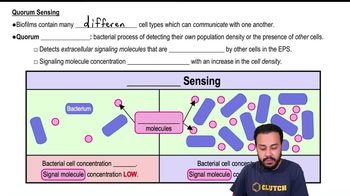
Understand the concept of quorum sensing: it is a communication mechanism used by bacteria to detect and respond to the density of their population through signaling molecules.
Recall that quorum sensing allows bacteria to coordinate certain behaviors that are more effective when performed by a group rather than by individual cells.
Review the options given and consider which bacterial activities are commonly regulated by quorum sensing, such as biofilm formation, virulence factor production, or bioluminescence.
Eliminate options that are unrelated to quorum sensing, such as mutation, DNA copying, or genetic transfer methods like transduction and conjugation, which are not directly controlled by quorum sensing.
Conclude that quorum sensing primarily helps cells to form biofilms, which are structured communities of bacteria adhering to surfaces and each other.
Risposta video verificata per un problema simile:
Questa soluzione video è stata consigliata dai nostri tutor come utile per risolvere questo problema.
Durata del video:
2m
Guarda un video:
0 Commenti
Concetti chiave
Ecco i concetti essenziali che devi comprendere per rispondere correttamente alla domanda.
Quorum Sensing
Quorum sensing is a communication mechanism used by bacteria to detect and respond to cell population density through signaling molecules. It enables coordinated behavior once a threshold concentration is reached, influencing gene expression and group activities.
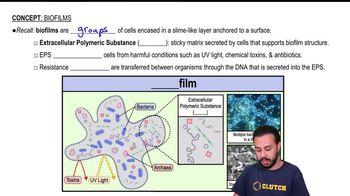
Biofilms are structured communities of microbial cells attached to surfaces and embedded in a self-produced extracellular matrix. Quorum sensing regulates biofilm formation by controlling genes involved in adhesion and matrix production, enhancing survival and resistance.
Processes like transduction and conjugation involve the transfer of genetic material between bacteria. These mechanisms are distinct from quorum sensing, which primarily regulates group behaviors rather than directly mediating DNA transfer or mutation.

 2:06 minuti
 Guida verificata passo dopo passo
 04:13
04:13