Skip to main content
Microbiology
Il mio corso
Impara
Preparazione agli esami
AI Tutor
Guide di studio
Soluzioni per libri di testo
Flashcard
Esplora
Prova l'app
Il mio corso
Impara
Preparazione agli esami
AI Tutor
Guide di studio
Soluzioni per libri di testo
Flashcard
Esplora
Prova l'app
Indietro
Chargaff's Rules quiz
Puoi toccare per girare la carta.
Who was the scientist that made two key discoveries about DNA in the early 1950s?
Puoi toccare per girare la carta.
👆
Who was the scientist that made two key discoveries about DNA in the early 1950s?
Erwin Chargaff made two key discoveries about DNA in the early 1950s.
Avanzamenti del tracciato
I pulsanti di controllo sono stati cambiati in modalità "navigazione".
1/15
Flashcard correlate
Pratica correlata
Video consigliati
Chargaff's Rules definitions
Chargaff's Rules
14 Termini
Chargaff's Rules
14. DNA Replication
3 Problemi
Argomento
Nicole
Discovering the Structure of DNA
14. DNA Replication
3 Problemi
Argomento
Nicole
14. DNA Replication
10 Argomenti
14 Problemi
Capitolo
Brendan
04:33
Chargaff's Rules
12285
views
144
rank
Termini in questo insieme (15)
Nascondere definizioni
Who was the scientist that made two key discoveries about DNA in the early 1950s?
Erwin Chargaff made two key discoveries about DNA in the early 1950s.
What does Chargaff's first rule state about DNA base composition among species?
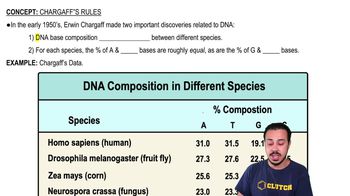
Chargaff's first rule states that DNA base composition varies among different species.
According to Chargaff's second rule, which DNA bases are present in roughly equal amounts in any species?
Adenine (A) is roughly equal to thymine (T), and guanine (G) is roughly equal to cytosine (C) in any species.
Why are the percentages of A and T, and G and C, roughly equal in DNA?
Because A pairs with T and G pairs with C through complementary base pairing in DNA.
What was unknown at the time of Chargaff's discoveries that made his findings so important?
The structure of DNA was unknown, so Chargaff's findings were crucial for understanding it.
How did Chargaff's data contribute to future research on DNA?
Chargaff's rules laid the groundwork for future research on the structure of DNA.
What did Chargaff observe about the DNA base composition in Homo sapiens compared to Escherichia coli?
He observed that the DNA base composition, or percentages of A, T, G, and C, varies between Homo sapiens and Escherichia coli.
Why are the percentages of A and T, and G and C, not exactly equal in Chargaff's data?
Slight discrepancies are due to limitations in Chargaff's experimental techniques.
What are the approximate percentages of A and T in human DNA according to Chargaff's data?
In humans, the percentage of A and T is roughly around 31% each.
What are the approximate percentages of G and C in human DNA according to Chargaff's data?
In humans, the percentage of G and C is roughly around 19% and 18% respectively.
Does the rule that A equals T and G equals C apply to all species?
Yes, Chargaff found that this rule applies to all species he studied.
What are the four nitrogenous bases found in DNA?
The four nitrogenous bases in DNA are adenine (A), thymine (T), guanine (G), and cytosine (C).
What did Chargaff's first discovery reveal about the uniqueness of species?
It revealed that each species has a unique DNA base composition.
How did Chargaff's findings help in revealing the structure of DNA?
His findings about base pairing ratios were critical clues that helped scientists deduce the double helix structure of DNA.
What is the main reason for slight differences in the percentages of complementary bases in Chargaff's data?
The main reason is the limitations in the experimental techniques available to Chargaff at the time.
 IndietroIndietro
 04:33
04:33