Skip to main content
Microbiology
Il mio corso
Impara
Preparazione agli esami
AI Tutor
Guide di studio
Soluzioni per libri di testo
Flashcard
Esplora
Prova l'app
Il mio corso
Impara
Preparazione agli esami
AI Tutor
Guide di studio
Soluzioni per libri di testo
Flashcard
Esplora
Prova l'app
Indietro
Hydrogen Bonding definitions
Puoi toccare per girare la carta.
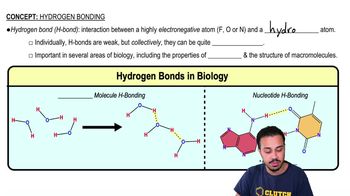
Hydrogen Bond
Puoi toccare per girare la carta.
👆
Hydrogen Bond
An interaction involving a hydrogen atom and a highly electronegative atom, crucial for many biological structures and properties.
Avanzamenti del tracciato
I pulsanti di controllo sono stati cambiati in modalità "navigazione".
1/13
Flashcard correlate
Pratica correlata
Video consigliati
Hydrogen Bonding quiz
Hydrogen Bonding
15 Termini
Hydrogen Bonding
3. Chemical Principles of Microbiology
3 Problemi
Argomento
Brendan
Ionic Bonding
3. Chemical Principles of Microbiology
3 Problemi
Argomento
Nicole
3. Chemical Principles of Microbiology
7 Argomenti
12 Problemi
Capitolo
Nicole
05:03
Hydrogen Bonding
22941
views
375
rank
Termini in questo insieme (13)
Nascondere definizioni
Hydrogen Bond
An interaction involving a hydrogen atom and a highly electronegative atom, crucial for many biological structures and properties.
Electronegativity
A property of certain atoms, like fluorine, oxygen, and nitrogen, that enables strong attraction to electrons in bonds.
Fluorine
A highly electronegative atom capable of forming strong interactions with hydrogen in biological molecules.
Oxygen
A key atom in water and macromolecules, known for its strong attraction to hydrogen in specific molecular interactions.
Nitrogen
An atom found in nucleotides and other molecules, often forming important interactions with hydrogen atoms.
Water Molecule
A compound consisting of two hydrogens and one oxygen, whose unique properties arise from specific atomic interactions.
Macromolecule
A large biological molecule whose structure and function often depend on collective weak interactions.
Nucleotide
A building block of genetic material, capable of forming specific interactions essential for DNA structure.
DNA
A genetic material whose double-helix structure is stabilized by multiple weak interactions between its components.
FON
A mnemonic for the three atoms—fluorine, oxygen, nitrogen—that commonly participate in specific weak interactions.
Biological Process
A series of events in living organisms that often rely on collective weak interactions for proper function.
Interaction
A non-covalent association between atoms or molecules, often contributing to the stability of biological systems.
Bond Strength
A measure of how easily an association between atoms can be disrupted, varying from weak individually to strong collectively.
 IndietroIndietro
 05:03
05:03